2026-05-28 東北大学
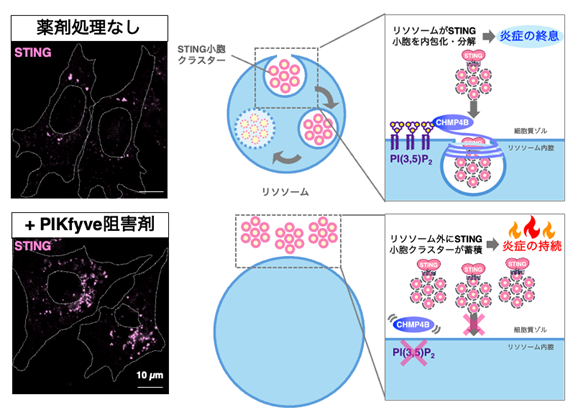
図1. 本研究の概要
通常時(上段)、STING小胞クラスターはリソソーム膜に局在するPI(3,5)P2とCHMP4Bの相互作用を介してリソソーム内腔に取り込まれます。このプロセスによりSTING炎症シグナルは終息します。一方でPikfyveを阻害した場合(下段)には、STING小胞クラスターがリソソームに取り込まれずに細胞質ゾルに蓄積し、炎症が持続してしまいます。
<関連情報>
- https://www.tohoku.ac.jp/japanese/2026/05/press20260528-01-sting.html
- https://www.nature.com/articles/s41467-026-72828-4
リソソーム上のPI(3,5)P2 / CHMP4B軸はSTINGのミクロオートファジー分解に不可欠である A PI(3,5)P2/CHMP4B axis on lysosomes is essential for microautophagic degradation of STING
Tsumugi Shoji,Ayumi Shinojima,Takuma Kishimoto,Kanako Sato,Nana Ikegami,Eisuke Yumoto,Ruri Shindo,Yasunori Uchida,Satoshi Kusumi,Daisuke Koga,Eiji Yamamoto,Yoshinori Hirano,Ryo Ogino,Hirofumi Shibata,Kazushi Izawa,Takahiro Yasumi,Ryota Sato,Jun Nakayama,Shigeki Higashiyama,Junya Hasegawa,Hiroaki Kajiho,Takehiko Sasaki,Yoshihiko Kuchitsu & Tomohiko Taguchi
Nature Communications Published:27 May 2026
DOI:https://doi.org/10.1038/s41467-026-72828-4
Abstract
Stimulator of interferon genes (STING) is critical for the type I interferon responses to pathogen- or self-derived cytosolic DNA. STING signalling is terminated by ESCRT-driven lysosomal microautophagy. How STING is directly encapsulated by lysosomes has not yet been understood. Here we show that two lysosomal components, a phosphoinositide PI(3,5)P2 and CHMP4B (a subunit of ESCRT-III subcomplex) are essential for STING encapsulation by lysosomes. Liposome sedimentation assay reveals that CHMP4B binds to PI(3,5)P2. The forced recruitment of the catalytic core of Pikfyve (a lipid kinase generating PI(3,5)P2) to early endosomes, recruits a fraction of CHMP4B to early endosomes. CHMP4B mutant, defective in the binding to PI(3,5)P2, cannot restore the microautophagic degradation of STING or the resolution of the STING signalling in cells depleted of Chmp4b. Our results reveal a molecular mechanism that terminates innate immune signalling at the lysosomal membrane.