2026-05-27 テキサス大学オースチン校
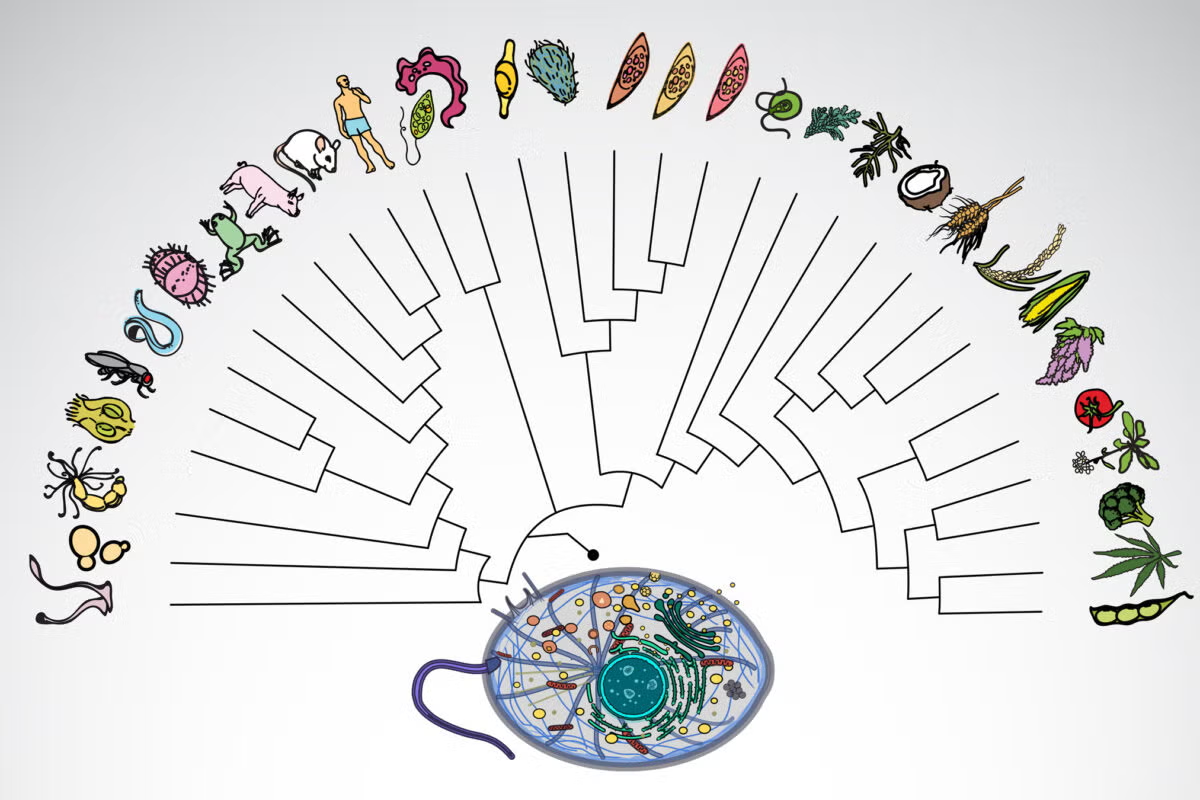
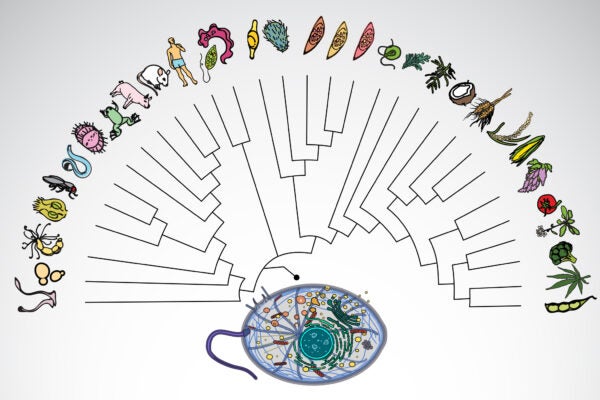
A University of Texas at Austin-led team used proteomics data from 31 eukaryote species, including humans, spanning ~1.8 billion years of evolution to reconstruct the protein interactome of the Last Eukaryotic Common Ancestor (LECA). Illustration credit: Angel Syrett/Elinor Marcotte/University of Texas at Austin/SwissBioPics.
<関連情報>
- https://news.utexas.edu/2026/05/27/scientists-map-proteins-from-billion-year-old-organism-and-discover-new-links-to-rare-diseases/
- https://www.cell.com/cell-genomics/fulltext/S2666-979X(26)00116-3
最後の真核生物共通祖先のタンパク質相互作用ネットワークは、現代の遺伝性疾患の生化学的基盤を明らかにする A protein interactome for the last eukaryotic common ancestor illuminates the biochemical basis of modern genetic diseases
Rachael M. Cox ∙ Ophelia Papoulas ∙ Shirlee Shril ∙ … ∙ Friedhelm Hildebrandt ∙ John B. Wallingford ∙ Edward M. Marcotte
Cell Genomics Published:May 27, 2026
DOI:https://doi.org/10.1016/j.xgen.2026.101254
Highlights
- Defines the core biochemical organization of eukaryotes for nearly two billion years
- Deep conservation and loss of vesicle tethering complexes
- Ciliary mechanism in human EFHC2-associated renal failure
- Implicates V-ATPase subunit ATP6V1A in the etiology of mammalian osteopetrosis
Summary
All eukaryotes share a single-celled ancestor from ∼1.5 to 1.8 billion years ago, the so-called last eukaryotic common ancestor (LECA). Roughly half of gene families found in modern eukaryotes were already present in LECA, forming molecular systems that continue to influence genetic diseases and traits today. To investigate these systems, we compared genes across 156 organisms to define a core set of protein-coding gene families likely present in LECA, with a quarter remaining uncharacterized. Integrating >26,000 mass spectrometry proteomics analyses from 31 species, we inferred higher-order complexes among these ancient proteins. This reconstructed interactome reveals both established and novel assemblies, offering a biochemical snapshot of LECA’s organization. Finally, by exploring these ancient protein interactions, we found new human gene-disease associations for bone density and congenital birth defects, illustrating the value of ancestral protein networks for modern functional genetics.