026-05-28 京都大学
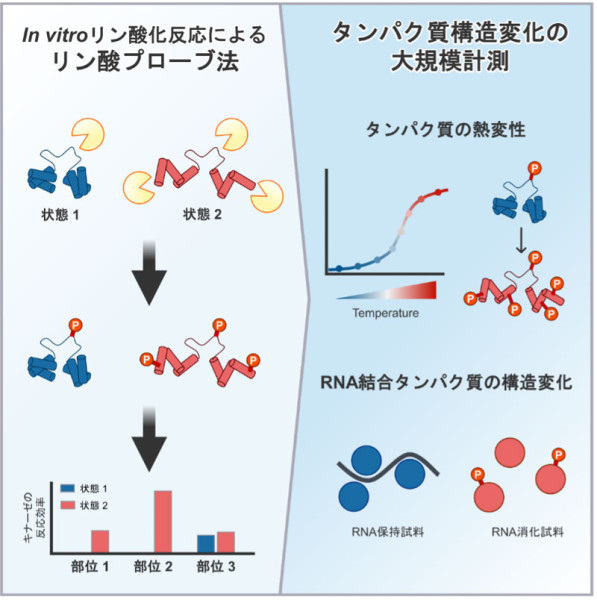
リン酸標識法の概要。基質タンパク質構造の違いはキナーゼのアクセス性を変えるため、キナーゼの反応効率の差を評価することで基質タンパク質の構造変化の検出が可能になる。京都大学 作成:前田朝登 京都大学大学院薬学研究科生体分子計測学分野
<関連情報>
- https://www.kyoto-u.ac.jp/ja/research-news/2026-05-28
- https://www.cell.com/cell-reports-methods/fulltext/S2667-2375(26)00166-9
キナーゼをリン酸標識化剤として用いたタンパク質高次構造変化の検出 Detecting protein higher-order structural changes using kinase as a phospho-labeler
Asato Maeda ∙ Kosuke Ogata ∙ Yasushi Ishihama
Cell Reports Methods Published:May 27, 2026
DOI:https://doi.org/10.1016/j.crmeth.2026.101466
Motivation
Mass spectrometry (MS)-based structural proteomics often relies on labeling solvent-exposed amino acid residues, followed by digestion and MS identification of labeled peptides. However, heterogeneous labeling patterns and the complexity of biological samples hinder proteome-wide analysis of protein higher-order structures. To overcome these challenges, we devised an approach that utilizes site-specific phosphate labeling, leveraging the intrinsic substrate recognition of protein kinases. The phosphate groups serve as enrichment handles, enabling selective isolation and sensitive detection of labeled sites.
Highlights
- Protein labeling with phosphate groups using in vitro kinase reaction
- Quantitative MS-based readout of in vitro phosphorylation efficiency
- In vitro phosphorylation efficiency reflects protein structural changes
- Proteome-wide and site-specific identification of protein structural changes
Summary
We developed an approach to detect protein structural changes on a proteome-wide scale by phosphate labeling through in vitro kinase reactions. This structural proteomics approach combines residue-specific labeling based on kinase substrate recognition with quantitative phosphoproteomics using phosphopeptide enrichment, enabling site-resolved profiling of structural alterations. Using myoglobin with and without heat denaturation and HEK293T cell extracts with and without protease treatment, we demonstrated that phosphorylation efficiency reflects differences in substrate protein structure. Moreover, by comparing phosphorylation efficiencies before and after RNA digestion, we successfully identified proteome-wide structural changes in non-denatured cell extracts. This approach enables a residue-specific readout of structural dynamics within the intracellular proteome.