2026-05-28 京都大学
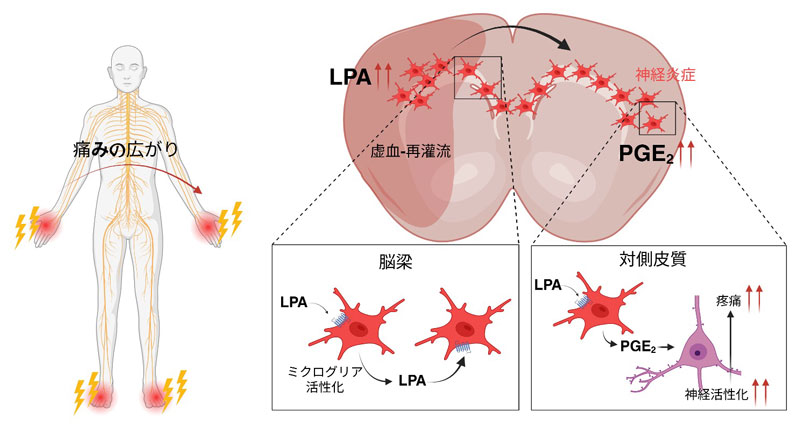
本研究の概要図。LPAはミクログリアを介して脳梁内に炎症シグナルを広げ、反対側の脳の神経炎症・痛みにつながる。(BioRender、作成者:根山広行)
<関連情報>
- https://www.kyoto-u.ac.jp/ja/research-news/2026-05-28-1
- https://www.nature.com/articles/s42003-026-10261-5
リゾホスファチジン酸は、脳梁を介した炎症反応の伝播によって、鏡像痛を引き起こす Lysophosphatidic acid drives to mirror-image pain via corpus callosum-mediated propagation of inflammatory responses
Hiroyuki Neyama,Ryoma Kizu,Rae Maeda,Hiroshi Ueda & Yuki Sugiura
Communications Biology Published:20 May 2026
DOI:https://doi.org/10.1038/s42003-026-10261-5 Unedited version
Abstract
Pain transmission is considered a unilateral process; however, development of bilateral hyperalgesia, including mirror-image pain (MIP), challenges this notion. The neural basis underlying bilateral hyperalgesia remains unclear. We investigated whether microglial activation within the corpus callosum is associated with interhemispheric propagation of inflammatory responses contributing to MIP. In a photothrombotic reperfusion mouse model, lysophosphatidic acid (LPA) signalling was associated with microglial activation in the contralateral corpus callosum and MIP development. Furthermore, PF8380 or minocycline suppressed bilateral hyperalgesia with MIP, supporting the therapeutic relevance of targeting LPA signalling and microglial activation. Together, these data support a model of an inflammatory circuit involving ischemic-core LPA, callosal microglia, contralateral insular PGE₂ signalling, and contralateral ACC activation that contribute to MIP. Because dysregulated LPA signalling and microglial activation are features of other neuroinflammatory conditions, transcallosal glial crosstalk may also contribute to widespread pain syndromes. Our findings highlight the therapeutic potential of targeting LPA-related pathways.