2026-04-20 浙江大学(ZJU)
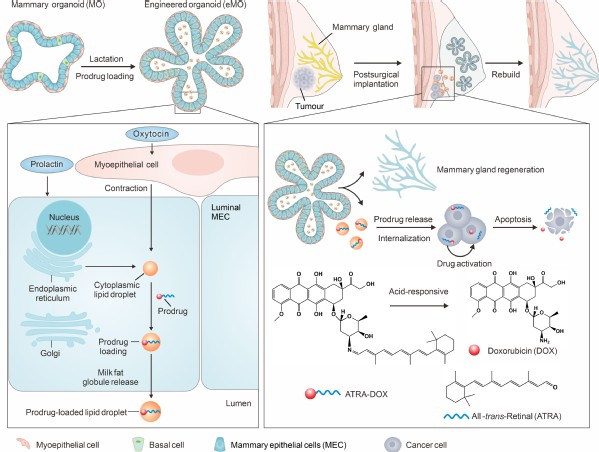
Fig.1 Schematic illustration of the construction of engineered mammary organoids and their application in post-surgical chemotherapy and mammary gland regeneration.
<関連情報>
- https://www.zju.edu.cn/english/2026/0420/c19573a3153728/page.psp
- https://www.nature.com/articles/s41551-026-01655-1
乳腺オルガノイドを基盤とした、術後化学療法および腺再生のための貯蔵庫 Mammary organoid-based depot for post-surgical chemotherapy and gland regeneration
Shenqiang Wang,Yinxian Yang,Yanfang Wang,Jinpeng Han,Tong Hu,Sheng Zhao,Feng Liu,Xinmin Yu,Tingxizi Liang,Yuqi Zhang,Huili Hu,Jicheng Yu & Zhen Gu
Nature Biomedical engineering Published:17 April 2026
DOI:https://doi.org/10.1038/s41551-026-01655-1
Abstract
Preventing cancer recurrence after surgical removal, while preserving breast cosmesis and restoring function, remains challenging. Traditional scaffold-based approaches are often restricted by their inadequate integration with natural tissues and unmatched rate of material degradation to tissue development. Here we report an anticancer drug secretion system based on engineered mammary organoids for inhibiting post-surgical tumour recurrence and promoting tissue reconstruction. By inducing the lactation of mammary organoids, cytoplasmic lipid droplets form intracellularly. A pH-responsive prodrug, comprising all-trans retinal and the chemotherapeutic agent doxorubicin, is readily encapsulated in these lipid droplets. Upon lactation, milk fat globules, enriched with these drug-loaded lipid droplets, are released to residual tumour cells through the contractile actions of myoepithelial cells. Both mouse and human-induced pluripotent stem cell-derived mammary organoids were engineered as drug-secreting depots and demonstrated their effectiveness in inhibiting tumour recurrence (96% regression) in a mouse post-surgical breast cancer model. In addition, the organoids could be self-adaptively integrated with mammary glands and contribute to their reconstruction, ultimately restoring lactational capacity in the recipient mice.