2026-10-07 東北大学
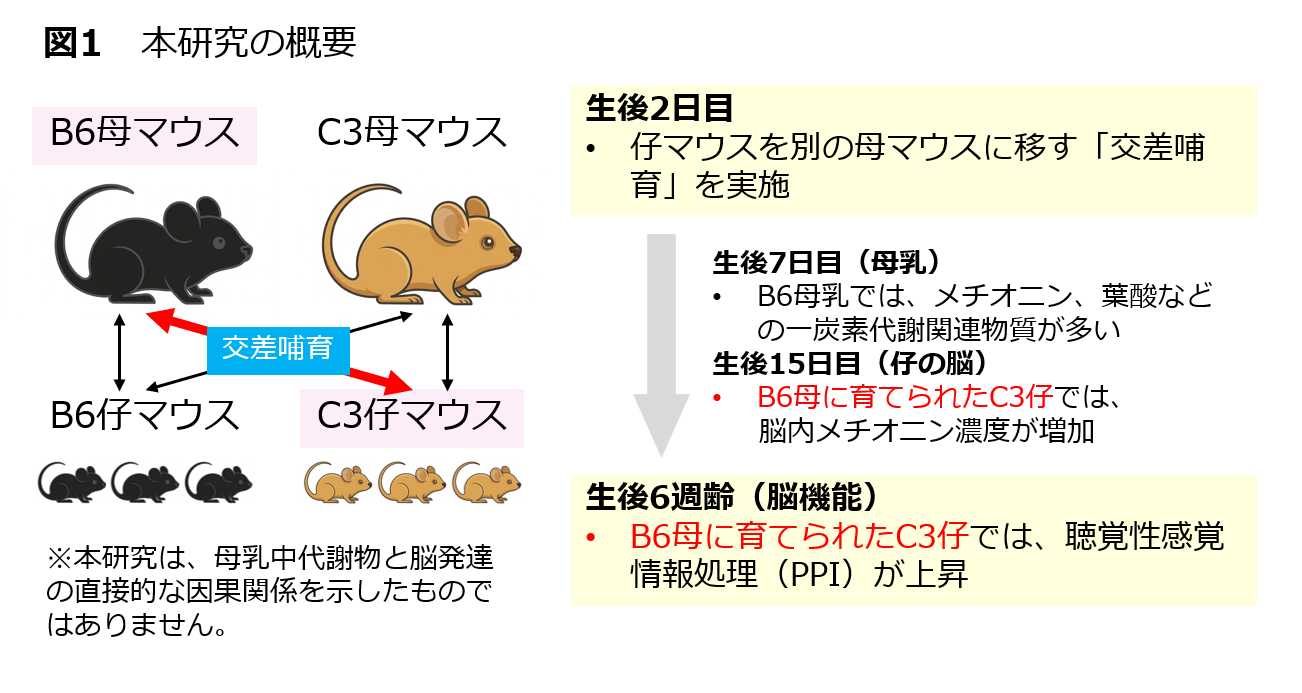
図1. 本研究の概要
<関連情報>
- https://www.tohoku.ac.jp/japanese/2026/10/press20261007-02-postnatal.html
- https://www.sciencedirect.com/science/article/pii/S0031938426002970
出生直後の母体環境は雄マウスのプレパルス抑制および脳内一炭素代謝産物に影響を与える The early postnatal maternal environment influences prepulse inhibition and brain one-carbon metabolites in male mice
Motoko Maekawa, Hongbo Wang, Hinako Kirikae, Anusree Kumar, Akiko Watanabe, Hisako Ohba, Yasuko Hisano, Tetsuo Ohnishi, Yuji Owada, Takeo Yoshikawa
Physiology & Behavior Available online: 19 September 2026
DOI:https://doi.org/10.1016/j.physbeh.2026.115514
Highlights
- Cross-fostering altered prepulse inhibition in male mice.
- Maternal milk from B6 and C3 dams showed distinct one-carbon-related metabolite profiles at postnatal day 7.
- Cross-fostering modified cortical methionine and homocysteine levels.
- Early postnatal maternal environments may influence neurodevelopmental programming.
Abstract
Maternal nutritional environments during early development are thought to influence neurodevelopmental and psychiatric disease susceptibility. While prenatal nutritional effects have been extensively studied within the developmental origins of health and disease (DOHaD) framework, the contribution of postnatal maternal environments remains less understood. In the present study, we investigated whether the postnatal maternal environment influences sensorimotor gating-related behavioral phenotypes and one-carbon metabolism-related metabolites using a cross-fostering paradigm between C57BL/6N (B6) and C3H/HeN (C3) mice, two strains exhibiting distinct prepulse inhibition (PPI) phenotypes. Male offspring were cross-fostered from postnatal day 2 to weaning, and behavioral analyses were performed at 6 weeks of age. Cross-fostering altered PPI responses, particularly in C3 offspring reared by B6 dams. Metabolomic analyses revealed strain-dependent differences in maternal milk metabolites at postnatal day 7 (P7). Maternal milk from B6 dams contained higher levels of methionine and several one-carbon metabolism-related metabolites than milk from C3 dams. Furthermore, cortical methionine and homocysteine levels in the offspring brain were altered by cross-fostering. These findings suggest that the postnatal maternal environment is associated with alterations in offspring one-carbon metabolism. We hypothesize that maternal milk-derived metabolites may represent one potential mechanism underlying these associations.