2026-10-29 合肥物質科学研究院(HFIPS)
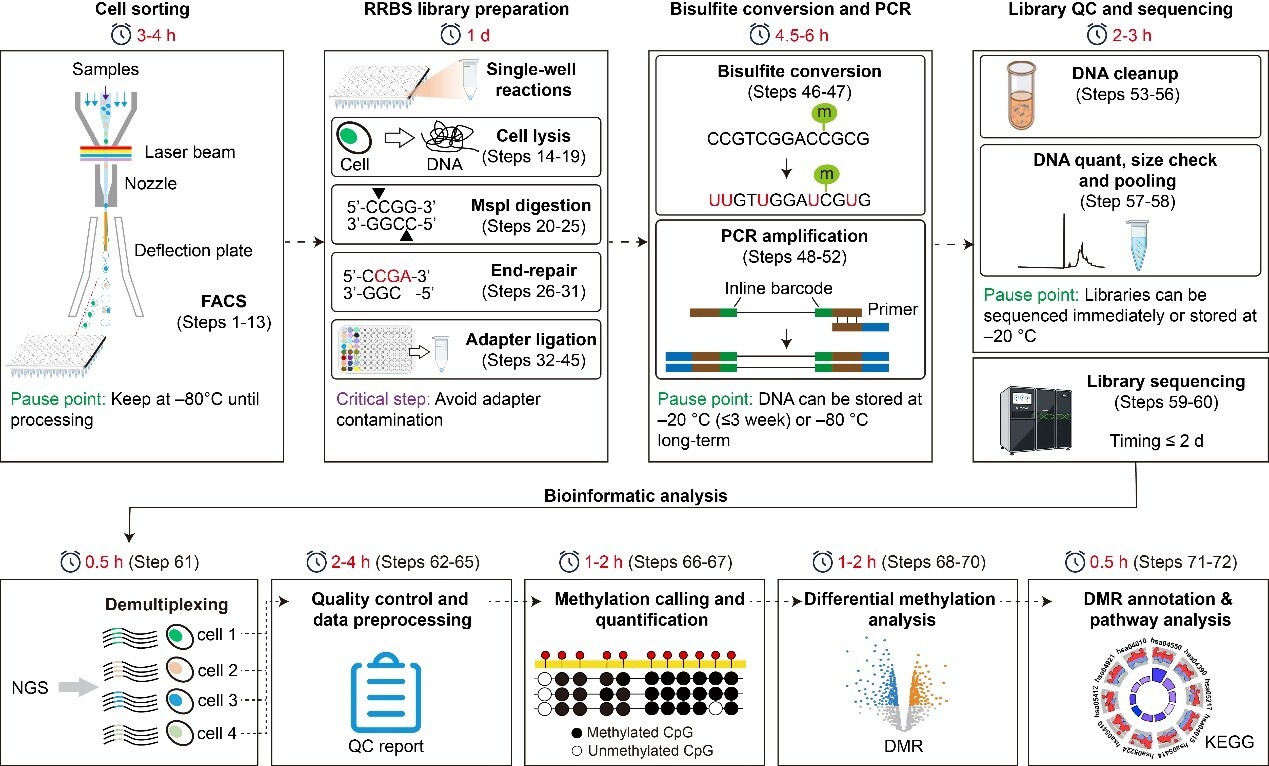
Workflow of Msc-RRBS library preparation and methylation analysis. (Image by GU Hongcang)
<関連情報>
- https://english.hf.cas.cn/nr/rn/202610/t20261029_1212844.html
- https://www.nature.com/articles/s41596-026-01452-9
ゲノムワイドDNAメチル化プロファイリングのための多重化単一細胞還元表現型ビスルフィットシーケンス Multiplexed single-cell reduced representation bisulfite sequencing for genome-wide DNA methylation profiling
Fang Liu, Jian Huang, Yanhua Zheng, Lina Fu, Xuanlu Wu, Ningning Zhao, Yunfei Wang, Andreas Gnirke, Alexander Meissner, Xiaoxue Wang, Fan Zhang & Hongcang Gu
Nature Protocols Published:15 October 2026
DOI:https://doi.org/10.1038/s41596-026-01452-9
Abstract
DNA methylation is a fundamental epigenetic modification that regulates gene expression, maintains genomic integrity and defines cellular identity. Conventional bulk sequencing methods, such as reduced-representation bisulfite sequencing (RRBS), have elucidated genome-wide methylation landscapes but do not reveal cell-to-cell variation, limiting insights into methylation heterogeneity during development, differentiation and disease. Here, we present multiplexed single-cell RRBS (Msc-RRBS), a streamlined and scalable protocol for parallel DNA methylation profiling of hundreds of individual cells. All enzymatic reactions, including cell lysis, restriction digestion, end repair and adapter ligation, are carried out in a single microwell, which eliminates the need for buffer exchange and minimizes DNA loss. Short, indexed adapters are used to efficiently remove adapter dimers and enable effective purification of library DNA by magnetic bead clean-up. The workflow supports the generation of sequencing libraries from single cells, pooled cells or sub-nanogram amounts of purified genomic DNA. The full workflow, from cell sorting to sequencing-ready libraries and data analysis, requires ~6 d for one or more 96-well plates. Msc-RRBS thus provides an efficient, reproducible and high-throughput approach for dissecting cell-to-cell DNA methylation heterogeneity across diverse biological and disease contexts. The experiments require basic molecular biology skills, and primary data processing can be performed by someone with limited bioinformatics training. More advanced analyses need additional computational expertise.
Key points
- Multiplexed single-cell reduced-representation bisulfite sequencing (Msc-RRBS) enables high-throughput methylation profiling of hundreds of single cells. The procedure involves cell lysis, restriction digestion, end repair and adapter ligation followed by bisulfite conversion, sequencing and optional downstream analysis.
- Msc-RRBS provides a practical balance of throughput, cost and data quality for profiling cell-to-cell methylation heterogeneity in development and disease.