2026-09-29 国立がん研究センター
<関連情報>
- https://www.ncc.go.jp/jp/information/researchtopics/2026/0929/index.html
- https://jamanetwork.com/journals/jamasurgery/fullarticle/2853288
直腸切除術における架橋コンドロイチン硫酸接着バリアシステム 無作為化臨床試験 Cross-Linked Chondroitin Sulfate Adhesion Barrier System in Open Rectal Resection A Randomized Clinical Trial
Yukihide Kanemitsu, MD; Eiji Hashizume, MD; Takeshi Suto, MD:et al
JAMA Surgery Published:August 26, 2026
DOI:10.1001/jamasurg.2026.3416
Key Points
Question Can the SI-449 adhesion barrier system reduce adhesions after open rectal resection for rectal cancer?
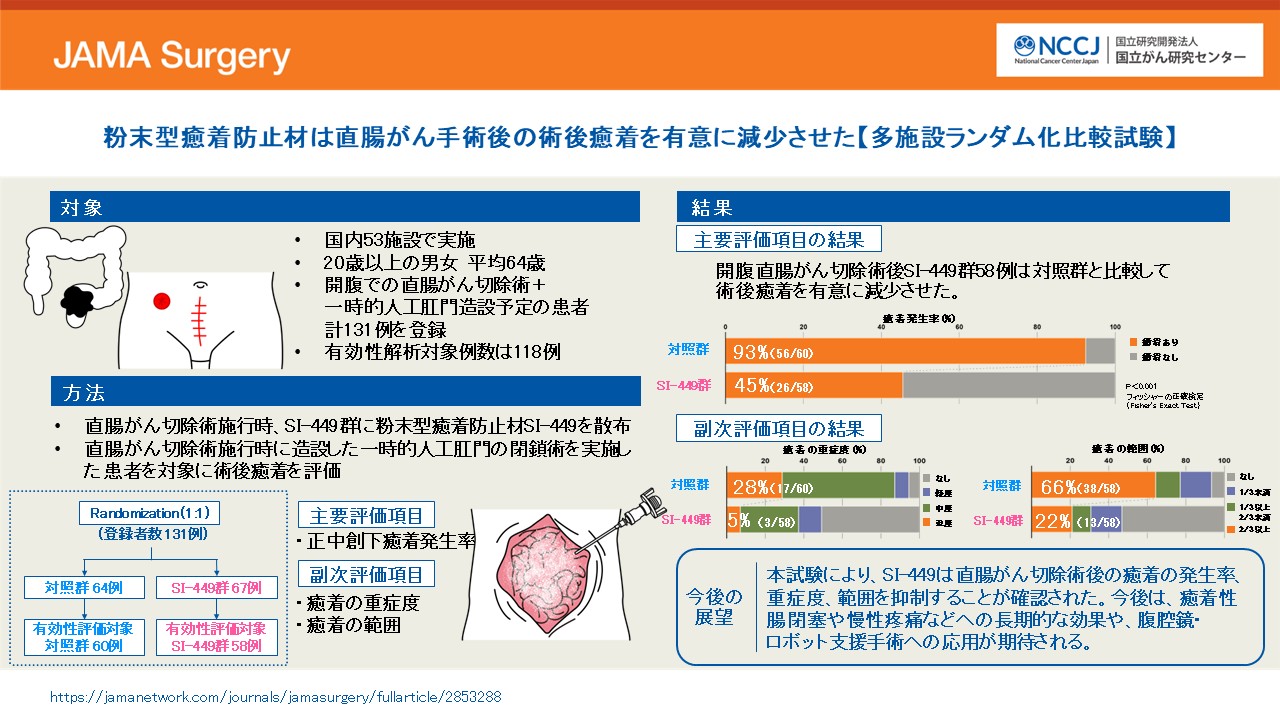
Findings In this randomized clinical trial, the adhesion barrier system significantly reduced the incidence, extent, and severity of adhesions in 118 patients with clinical stage I through IV rectal cancer undergoing open rectal resection and scheduled for follow-up ileostomy closure, with incidence of adhesions in the control and experimental groups of 56 of 60 patients (93%) and 26 of 58 patients (45%), respectively. This system exhibited good operability and ease of preparation before use, with no safety concerns.
Meaning Given the good operability of the adhesion barrier system and its reduction of the incidence, severity, and extent of adhesions under the midline incision wound without safety concerns, we suggest that the powdered form of SI-449 may be able to address needs unmet by existing anti-adhesion products.
Abstract
Importance Adhesions commonly occur after abdominal and pelvic surgery, causing infertility, intestinal obstruction, and pelvic pain. Existing anti-adhesion materials are often difficult to use on uneven organ surfaces, highlighting the need for novel solutions; SI-449, a cross-linked, powder-formed chondroitin sulfate (CS), may address these limitations.
Objective To evaluate the anti-adhesion effect of the SI-449 adhesion barrier system (cs barrier) in patients undergoing open rectal resection for rectal cancer.
Design, Setting, and Participants This multicenter, prospective, randomized, open, and blinded–end point (PROBE) method pivotal clinical trial was conducted at 53 hospitals in Japan from September 2020 to June 2023. The study participants and efficacy assessors on the central review board were blinded. Patients aged 20 years or older with clinical stage I through IV rectal cancer who underwent open rectal resection and were scheduled for follow-up ileostomy closure were eligible for inclusion. Data were analyzed from July 2023 through September 2023.
Intervention The control group received no additional procedure before abdominal closure, while the experimental group received 2 to 3 g of SI-449 applied to the abdominal or pelvic cavity immediately before closure.
Main Outcomes and Measures The primary end point was the incidence of adhesions under the incision. Secondary end points included adhesion number, severity, and extent; number and type of adhered organs; and number of adhesions per organ. Safety and operability were also evaluated.
Results Among 155 screened patients, 131 met the inclusion criteria and were randomized. Of these, 128 underwent the intervention (safety analysis population; control group: n = 64; experimental group: n = 64), and 118 completed a second surgery (modified intention-to-treat population; control group: n = 60; experimental group: n = 58). Overall mean (SD) patient age was 68.2 (10.3) years, and 34 patients of 118 (29%) were female. Adhesion incidence was significantly lower in the experimental group (26 of 58 [45%]) compared to the control group (56 of 60 [93%]) (P < .001). The experimental group also showed significantly reduced adhesion severity and extent. No safety concerns were identified, and operability was good.
Conclusions and Relevance In this randomized clinical trial, SI-449 in the powdered form reduced the incidence of adhesions, and the adhesion barrier system had good operability and no safety concerns. Thus, this system may provide a new anti-adhesion option for use in open surgery.
Trial Registration jrct.mhlw.go.jp Identifier: jRCT1080225247