2026-11-19 東京大学
<関連情報>
- https://www.i.u-tokyo.ac.jp/news/press/2026/202611192929.shtml
- https://www.science.org/doi/10.1126/sciadv.aej5555
言語と数学にまたがる共有および領域固有の神経表現を明らかにするクロスドメイン符号化モデル
Cross-domain encoding models reveal shared and domain-specific neural representations across language and mathematics
Tomoya Nakai, Rieko Kubo, Shinji Nishimoto
Science Advances, 12(47), eaej5555 電子公開日:2026-11-18
DOI:10.1126/sciadv.aej5555

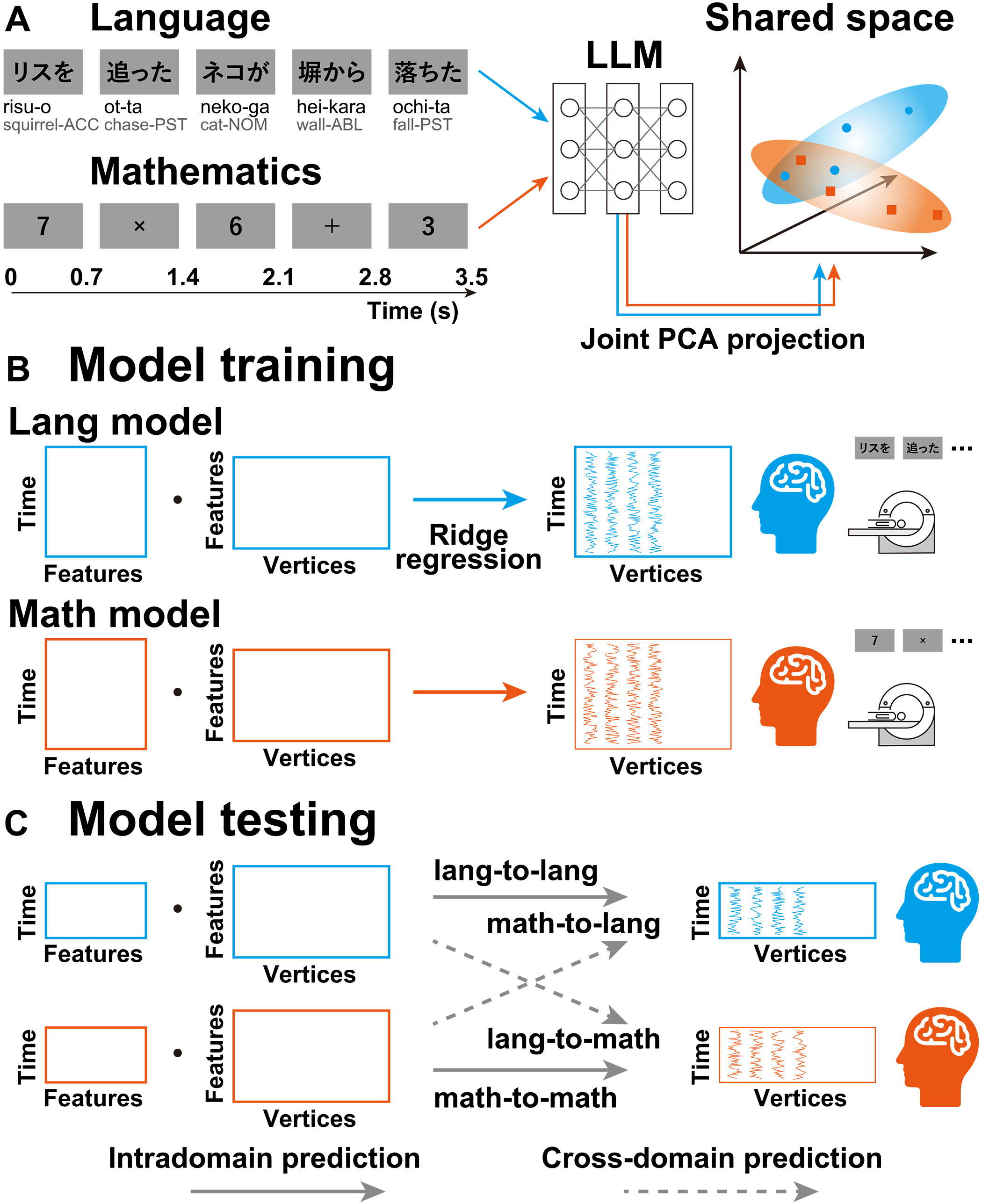
本研究は、文章の読解と数学的計算が脳内で共通の情報表現を利用するのか、それとも異なる神経表現に依存するのかという認知神経科学上の課題を検討したものである。研究チームは、日本語を母語とする32名を対象に、文章理解課題と計算課題を実施し、その際の脳活動を機能的磁気共鳴画像法(fMRI)で測定した。さらに、大規模言語モデルLlama 3から文章と数式の特徴量を抽出し、共通の潜在特徴空間に変換して脳活動を予測するエンコーディングモデルを構築した。一方の課題で学習したモデルを他方の課題に適用するクロスドメイン予測により、左前頭葉の55b野を中心とする脳領域で、読解と計算に共通する情報表現が確認された。この結果は、単純な視覚処理や運動、記憶・注意などの一般的な認知要因だけでは説明できなかった。一方、読解では左上側頭溝や角回、計算では左前中心溝および両側の頭頂間溝で、それぞれに特徴的な情報表現が認められた。また、55b野は課題に応じて異なる脳ネットワークと機能的に結び付いていた。本研究は、言語と数学が共通の情報処理基盤と領域固有の神経機構を併せ持つことを示しており、認知機能の理解や学習支援技術の開発に貢献する可能性がある。
This study investigated whether language comprehension and mathematical calculation rely on shared or distinct neural representations. The researchers recruited 32 native Japanese speakers who performed sentence comprehension and calculation tasks while their brain activity was measured using functional magnetic resonance imaging (fMRI). Features extracted from the large language model Llama 3 were mapped into a common latent feature space and used to construct neural encoding models. By applying models trained on one task to predict brain activity during the other task, the researchers identified partially shared neural representations, most prominently in left cortical area 55b. These cross-domain prediction effects could not be fully explained by basic visual or motor processing or general cognitive factors such as memory and attention. In contrast, language-related representations were more prominent in the left superior temporal sulcus and angular gyrus, whereas mathematics-related representations were stronger in the left precentral sulcus and bilateral intraparietal sulci. Functional connectivity analyses further revealed that area 55b interacted with different networks depending on whether participants were reading or performing calculations. These findings suggest that language and mathematics share certain underlying neural representations while retaining domain-specific cortical organization. The study provides new insights into the neural foundations of human cognition and may contribute to future educational and learning-support technologies.