2026-11-18 東京大学
<関連情報>
- https://www.k.u-tokyo.ac.jp/information/category/press/0030569.html
- https://royalsocietypublishing.org/rspb/article/293/2083/20262155/484210/Stepwise-evolution-of-composite-phenotypes
複合的な表現型の段階的進化が光共生の成立をもたらす
Stepwise evolution of composite phenotypes underlies the emergence of photo-endosymbiosis
Colin J. Anthony, Yuu Ishii, Baptiste Genot, Mayu Ishikawa, Yuxin Liu, Masayuki Hatta, Shinichiro Maruyama
Proceedings of the Royal Society B: Biological Sciences 293巻、2083号、20262155: 2026年11月18日
DOI: https://doi.org/10.1098/rspb.2026.2155
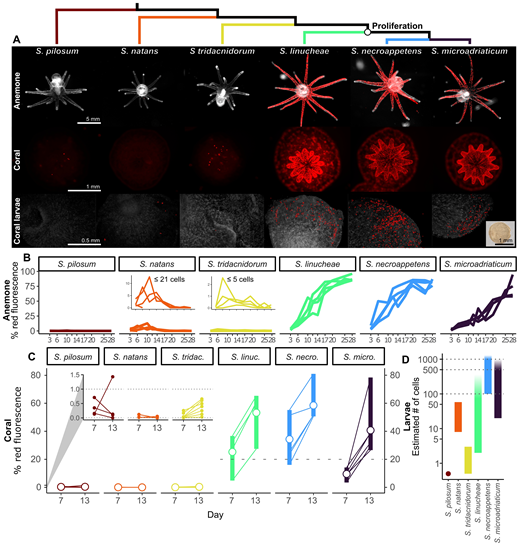
Integration, persistence and proliferation of Symbiodinium spp. within cnidarian model systems.

This study investigates the evolutionary transition from free-living algae to stable intracellular photo-endosymbionts, a relationship essential to the formation and maintenance of coral reefs. The researchers introduced six species of the dinoflagellate genus Symbiodinium into three cnidarian model systems: the sea anemone Exaiptasia diaphana, Acropora tenuis primary polyps, and coral planula larvae. The experiments revealed that symbiosis involves distinct stages of host integration, intracellular persistence, and proliferation, with only three of the six species demonstrating sustained proliferation within host cells. Comparative genomic analyses further identified enrichment of carbohydrate-related gene groups in proliferative species, together with positively selected mutations in a glycoside hydrolase family 3 (GH3) enzyme. Cellulase inhibition experiments showed that the cell cycles of non-proliferative species were more sensitive to the inhibitor, whereas proliferative species responded more slowly. These findings suggest that adaptations involving carbohydrate metabolism and cell-wall maintenance may contribute to the acquisition of intracellular proliferation. However, the precise functional role of GH3 mutations in establishing symbiosis remains unresolved and requires further experimental validation.