2025-07-21 ハーバード大学
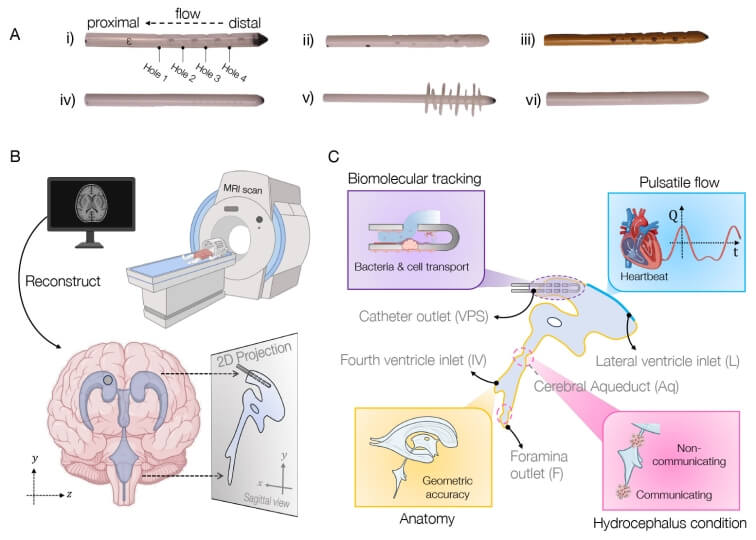
Schematic of approach to simulating brain shunt fluid dynamics.
<関連情報>
- https://seas.harvard.edu/news/2025/07/designing-better-brain-shunts
- https://www.pnas.org/doi/10.1073/pnas.2426067122
脳室システムの流体力学モデル Fluid dynamics model of the cerebral ventricular system
Haritosh Patel, Yu Xuan Huang, Duygu Dengiz, +3 , and Joanna Aizenberg
Proceedings of the National Academy of Sciences Published:June 25, 2025
DOI:https://doi.org/10.1073/pnas.2426067122
Significance
Hydrocephalus, a condition marked by excess cerebrospinal fluid (CSF) in the brain, affects millions globally and is predominantly treated using ventricular shunts. However, these devices often fail due to blockages caused by biological debris, leading to revision surgeries and poor patient outcomes. Our work introduces BrainFlow, a computational model that integrates brain anatomy, CSF flow patterns, and biomolecular transport phenomenon to simulate shunt performance with higher accuracy. By leveraging patient-specific imaging and fluid dynamics, BrainFlow offers improvements over conventional box-like simulations, and reveals critical insights into shunt obstructions and offers potential strategies for optimizing shunt design. This research contributes to the development of next-generation, patient-tailored devices, with the aim of supporting reliability and quality of life for individuals with hydrocephalus.
Abstract
Hydrocephalus, a neurological condition characterized by an excessive buildup of cerebrospinal fluid (CSF) in the brain, affects millions worldwide and leads to severe consequences. Current treatments, such as ventriculoperitoneal shunts, divert excess CSF from the brain but often face complications, mainly due to shunt obstructions caused by biological matter accumulation. While previous shunt designs aimed to improve fluid flow and reduce occlusion, they often lacked the precision needed for real-world applications due to simplified simulation models that did not fully capture the dynamics of the cerebral ventricular system. Here, we introduce BrainFlow, a computational model that integrates detailed anatomical and physiological features to simulate CSF dynamics in the presence of shunt implants. BrainFlow incorporates patient-specific medical imaging data, pulsatile flow to mimic cardiac cycles, adjustable parameters for various hydrocephalus conditions, and a biomolecule tracking feature to evaluate the long-term risk of shunt occlusion due to flow-mediated biomolecular transport. This model provides a more nuanced understanding of the factors contributing to shunt obstruction, offering insights into optimal shunt placement, design, and materials choice. Through validation against four-dimensional MRI flow data, BrainFlow demonstrates robust accuracy across multiple flow metrics. Our work lays the groundwork for the development of next-generation shunts tailored to individual patient anatomy and pathology, ultimately aiming to improve hydrocephalus treatment through informed, patient-specific design strategies.