2026-10-30 国立がん研究センター,川崎医科大学,大阪医科薬科大学
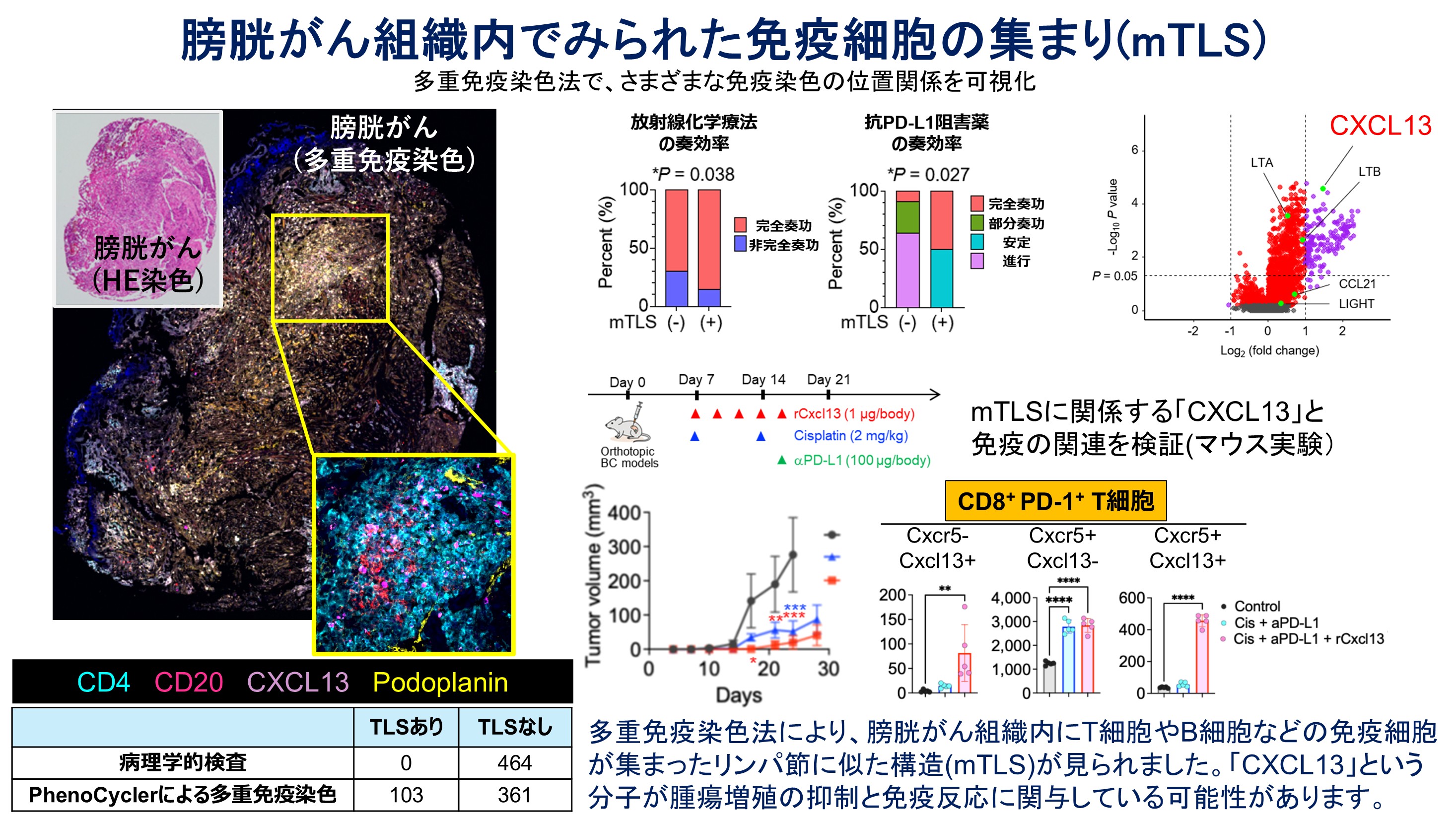
図 膀胱がん組織内でみられた免疫細胞の集まり
<関連情報>
- https://www.ncc.go.jp/jp/information/researchtopics/2026/1030_2/index.html
- https://aacrjournals.org/clincancerres/article-abstract/doi/10.1158/1078-0432.CCR-26-1878/789478/Multiplex-Immunofluorescence-Defined-CXCL13
多重免疫蛍光染色で同定されたCXCL13関連TLS様ニッチは膀胱癌の予後を予測する Multiplex Immunofluorescence–Defined CXCL13-Associated TLS-like Niches Predict Outcomes in Bladder Cancer
Ryoichi Maenosono; Kazuki Nishimura; Takuya Tsujino; Yuki Yoshikawa; Kensuke Hirosuna ; Moritoshi Sakamoto ; Tomohisa Matsunaga ; Maiko Seki ; Asuka Kawachi; Takuya Izumi-Tamura; Junko Mukohyama; Natsuko Shinohara; Mayumi Hanzawa; Marimu Sakumoto; Mitsuaki Ishida; Junko Zenkoh; Masahiko Ajiro; Yutaka Suzuki; Kazumasa Komura; Haruhito Azuma ; Akihide Yoshimi
Clinical Cancer Research Published:October 21 2026
DOI:https://doi.org/10.1158/1078-0432.CCR-26-1878
Abstract
Purpose:
Spatially organized tertiary lymphoid structure (TLS)–like niches may provide prognostic and therapeutic information beyond individual immune mediators such as CXCL13 in bladder cancer. We evaluated the clinical and translational significance of multiplex immunofluorescence (mIF)–defined TLS-like structures (mTLS) in bladder cancer.
Experimental Design:
We analyzed 469 clinically annotated bladder cancer tumors using 41-plex mIF with the PhenoCycler platform. Bulk RNA sequencing, CIBERSORTx deconvolution, Cox modeling with CXCL13 as a continuous variable, and spatial neighborhood analysis were used to define mTLS-associated immune programs. Orthotopic bladder cancer mouse models treated with cisplatin and/or recombinant Cxcl13 followed by anti–PD-L1 blockade were analyzed by flow cytometry.
Results:
mTLS were identified in 22.2% of tumors and were not apparent on routine histopathology. mTLS positivity was associated with immune activation, improved survival, and favorable response patterns in a small PD-L1 blockade–treated subset. In Cox models, mTLS remained independently associated with outcomes, whereas continuous CXCL13 expression was not significant. Spatial profiling showed CXCL13/CXCR5-enriched B- and T-cell neighborhoods, including CXCL13-expressing and CXCR5-positive CD8+ T-cell subsets. In mouse models, cisplatin plus exogenous Cxcl13 was associated with lymphocyte infiltration, enrichment of CD8+ PD-1+ and CD8+ Cxcr5+ Cxcl13+ T-cell states, and sustained tumor control after PD-L1 blockade.
Conclusions:
mIF-defined mTLS identify a clinically relevant spatial immune architecture linked to favorable outcomes and therapeutic responsiveness in bladder cancer. These findings support prospective evaluation of mTLS as a spatial biomarker for risk stratification and treatment sequencing, with CXCL13/CXCR5 features interpreted as contextual companion markers rather than standalone determinants.