
2026-10-10 筑波大学
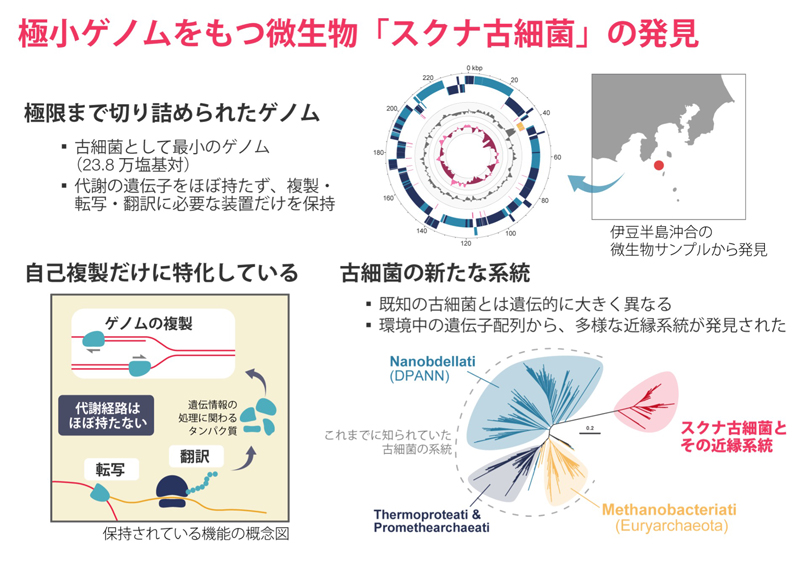
本研究の概要図
<関連情報>
- https://www.tsukuba.ac.jp/journal/biology-environment/20261010000000.html
- https://www.tsukuba.ac.jp/journal/pdf/p20261010000000.pdf
- https://www.cell.com/current-biology/abstract/S0960-9822(26)01251-0
複製の中核的機能のみを残した超縮小ゲノムを持つ、見過ごされてきた古細菌系統 A hidden archaeal lineage with an ultra-reduced genome retaining only its replicative core
Ryo Harada ∙ Yuki Nishimura ∙ Mami Nomura ∙ … ∙ Thorsten Allers ∙ Yuji Inagaki ∙ Takuro Nakayama
Current Biology Published:October 9, 2026
DOI:https://doi.org/10.1016/j.cub.2026.09.042
Highlights
- Sukunaarchaeum has a 238-kb genome, the smallest reported for any archaeon
- The genome retains a full informational core but almost no metabolic genes
- It defines an overlooked archaeal clade with diverse relatives in the global ocean
Summary
Host-associated prokaryotes can undergo extreme genome reduction, but the most reduced genomes belong to mutualistic endosymbionts whose hosts compensate for lost functions, eroding the symbiont’s identity as an autonomous cell. Whether comparable reduction can occur while preserving the informational autonomy of a cell remains unclear. Here, we report the discovery of Candidatus Sukunaarchaeum mirabile, an archaeon with a genome of only 238 kbp (less than half the size of the smallest known archaeal genome) obtained by single-cell genomics from a dinoflagellate cell. Phylogenetic analyses reveal Sukunaarchaeum as an extremely divergent lineage that cannot be placed within any recognized archaeal phylum, although its precise branching position remains unresolved; environmental surveys indicate a diverse, geographically dispersed, and previously overlooked clade. Its genome lacks virtually all recognizable metabolic pathways yet retains the catalytic cores of the machinery for DNA replication, transcription, and translation, with losses largely confined to auxiliary and regulatory subunits. This profile contrasts with that of highly reduced mutualistic endosymbionts, in which informational genes are lost alongside metabolic ones, eroding autonomous cellular identity: Sukunaarchaeum encodes no recognizable metabolic pathway that could benefit a host, and instead dedicates ∼25% of its genome to large membrane proteins of unknown function, a feature paralleled by host-invasion proteins in parasitic archaea. These observations argue against a mutualistic mode of host dependence and reveal a second, distinct endpoint of cellular reduction: the informational core may represent the practical lower bound for a cell that retains the capacity to replicate and express its own genome.

