2026-08-24 東京科学大学
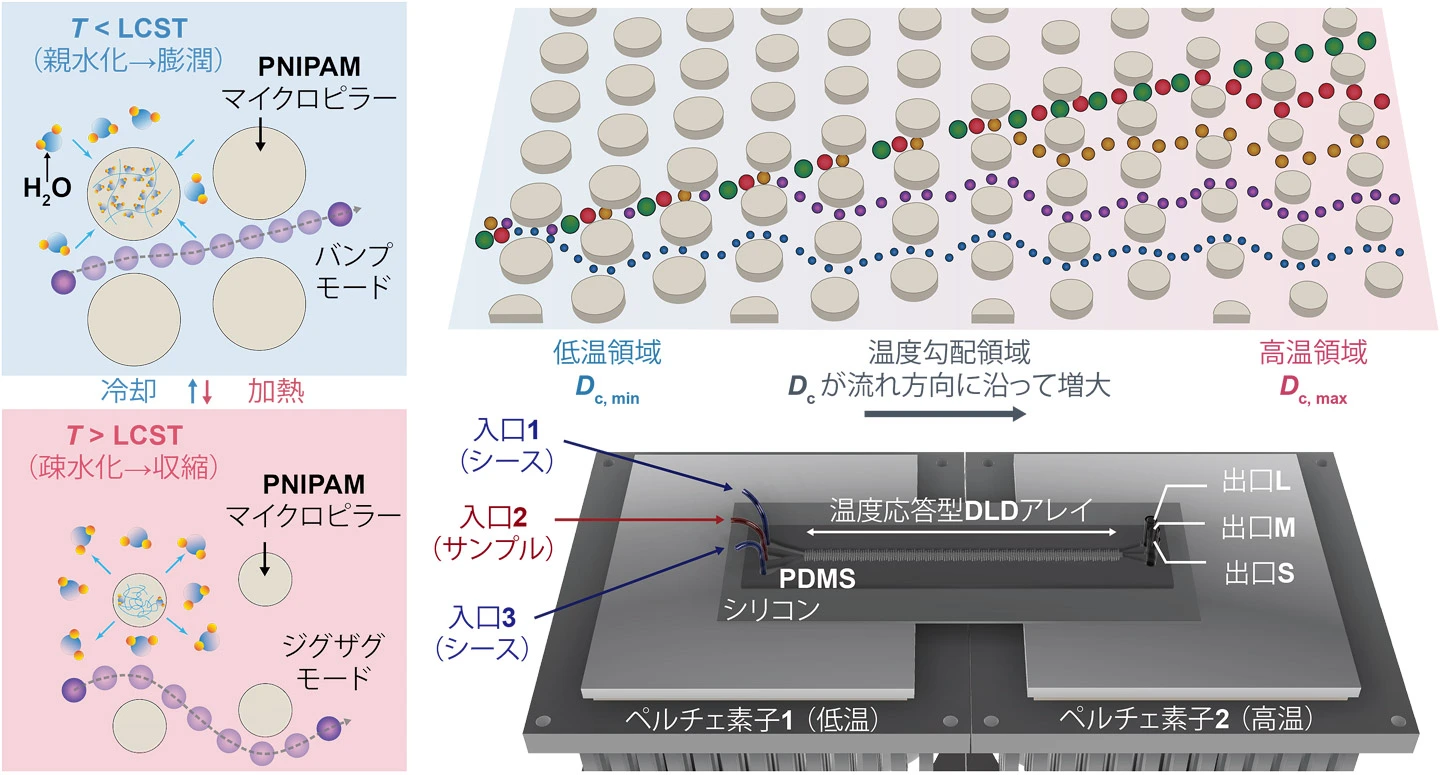
図1. 空間プログラム型DLDの原理とデバイス構成。低温側ではPNIPAMピラーが膨らみ、高温側では縮むため、流路に沿って臨界径が増加し、粒子・細胞の移動様式が位置ごとに変わる。
<関連情報>
- https://www.isct.ac.jp/ja/news/skyxt0nbo4hj
- https://pubs.rsc.org/lc/article-abstract/doi/10.1039/d6lc00402d/1286975/Spatially-programmable-deterministic-lateral
多段階マイクロ流体分離のための空間的にプログラム可能な決定論的横方向変位
Spatially programmable deterministic lateral displacement for multi-stage microfluidic separation
Ze Jiang;Yusuke Kanno;Takasi Nisisako
Lab on a Chip Published:29 July 2026
DOI:https://doi.org/10.1039/d6lc00402d
Deterministic lateral displacement (DLD) is a widely used microfluidic technique for continuous size-based separation. However, a conventional uniform DLD array is characterized by a single critical diameter (Dc) fixed by its geometry, restricting its ability to fractionate complex samples containing multiple particle populations. Here we present a DLD platform that spatially programs the geometrically estimated Dc after fabrication by thermally modulating the pillar geometry along a single array. Two independently controlled Peltier elements establish a longitudinal temperature field that progressively changes the pillar diameter and inter-pillar gap, generating an estimated Dc(x) profile ranging from 4.7 to 19.2 μm within an array fabricated with uniform initial geometry. As particles traverse the array, size-dependent transitions between bump and zigzag migration modes occur at different positions, producing distinct cumulative lateral displacements and enabling sequential separation within a single device. Using the three-outlet architecture, the device further enables reconfigurable grouping of a four-component particle mixture into three outlet fractions by shifting the applied temperature window. Furthermore, the platform selectively isolated tumor cells, white blood cells, and red blood cells from diluted whole-blood samples spiked with MCF-7 cells. A descriptive assay indicated high post-processing viability of the MCF-7 cells. By enabling post-fabrication programming of the operating separation profile, this work demonstrates how the same physical array can be reconfigured for different separation tasks by changing the applied temperature window.