2026-08-24 京都大学
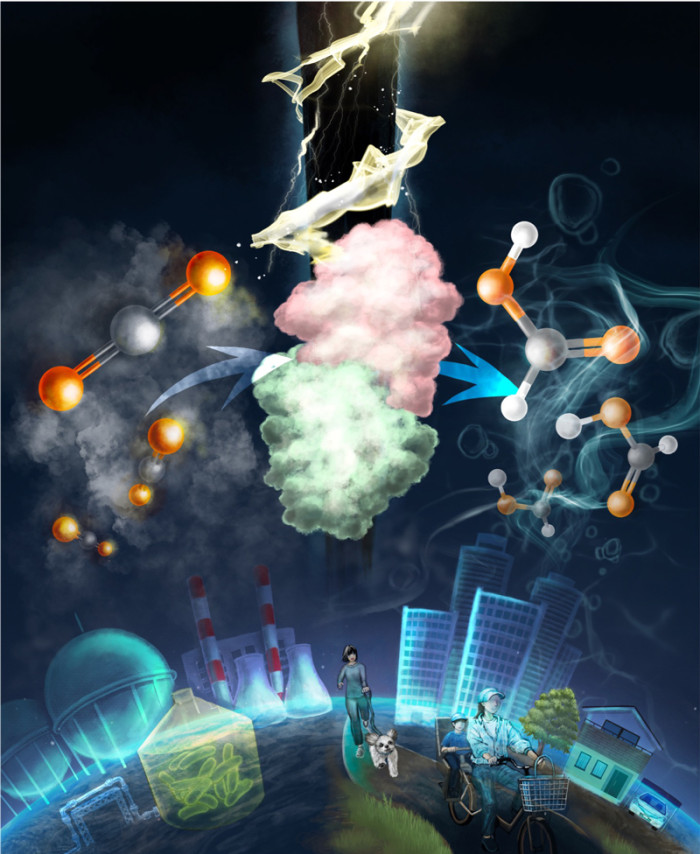
FoDH1によるガス状CO₂からギ酸への資源化 ©️京都大学(イラストレーター:田中花音)
<関連情報>
- https://www.kyoto-u.ac.jp/ja/research-news/2026-08-24
- https://pubs.acs.org/acsodf/article/11/32/47701/5239816/Direct-Electron-Transfer-Type-Gas-Diffusion
低濃度CO2条件下での効率的なCO2/ギ酸変換に向けた直接電⼦移動型ガス拡散型電極の構築 Direct Electron Transfer-Type Gas Diffusion Electrode for Efficient CO2-to-Formate Bioconversion across Broad and Low CO2 Levels
Ami Kobayashi;Taiki Adachi;Konatsu Ichikawa;Yuki Kitazumi;Osamu Shirai;Keisei Sowa
ACS Omega Published:August 03, 2026
DOI:https://doi.org/10.1021/acsomega.6c02909
Abstract
Bioelectrocatalytic CO2 reduction to value-added chemicals offers a sustainable route for carbon recycling; however, achieving high activity under low CO2 conditions remains a major challenge. Herein, we report a direct electron transfer (DET)-type gas diffusion electrode (GDE) utilizing formate dehydrogenase 1 (FoDH1) from Methylorubrum extorquens AM1 for efficient CO2-to-formate conversion across a broad range of low CO2 levels. The electrode surface was modified with pyrene derivatives using multiwalled carbon nanotubes (MWCNTs) to tailor the enzyme–electrode interface, enabling favorable enzyme orientation for rapid electron transfer. A 1-pyrenemethylamine (PyNH2)-modified GDE with FoDH1 exhibited a current density of −1.2 mA cm–2 at a reduction potential of −0.9 V, which was twice that of the pristine electrode, and generated formate with a Faradaic efficiency of 82 ± 5%, outperforming previously reported GDE systems. Kinetic analyses under controlled CO2 conditions (0.04–100%) revealed a notably low apparent Michaelis constant (KM,app) of 2.6 ± 0.3%, which is less than one-third of that of the solution system, indicating high CO2 affinity. This enhancement is attributed to the direct supply of gaseous CO2 to the catalytic layer, avoiding equilibrium limitations in the electrolyte solution. These results lead to a promising tool for enzymatic CO2 reduction using emission gases from industrial sources and provide key design principles for practical CO2-recycling technologies.