2022-04-27 テキサス大学オースチン校(UT Austin)
この発見は、本日『Nature』誌に掲載されました。この発見は、世界で最も差し迫った環境問題の一つである、埋立地に積み上げられ、自然の土地や水を汚染している何十億トンものプラスチック廃棄物をどうするかという問題の解決に役立つ可能性があります。この酵素は、分子レベルでプラスチックを回収し再利用することで、主要産業が環境負荷を低減できるような大規模なリサイクルを促進する可能性を持っています。
<関連情報>
- https://news.utexas.edu/2022/04/27/plastic-eating-enzyme-could-eliminate-billions-of-tons-of-landfill-waste/
- https://www.nature.com/articles/s41586-022-04599-z
機械学習を援用したPET解重合用ヒドロラーゼの創製 Machine learning-aided engineering of hydrolases for PET depolymerization
Hongyuan Lu,Daniel J. Diaz,Natalie J. Czarnecki,Congzhi Zhu,Wantae Kim,Raghav Shroff,Daniel J. Acosta,Bradley R. Alexander,Hannah O. Cole,Yan Zhang,Nathaniel A. Lynd,Andrew D. Ellington & Hal S. Alper
Nature Published: 27 April 2022
DOI:https://doi.org/10.1038/s41586-022-04599-z
Abstract
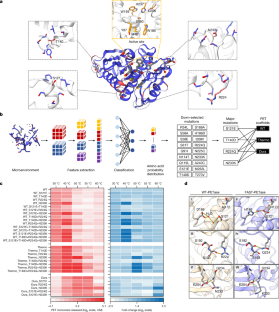
Plastic waste poses an ecological challenge1,2,3 and enzymatic degradation offers one, potentially green and scalable, route for polyesters waste recycling4. Poly(ethylene terephthalate) (PET) accounts for 12% of global solid waste5, and a circular carbon economy for PET is theoretically attainable through rapid enzymatic depolymerization followed by repolymerization or conversion/valorization into other products6,7,8,9,10. Application of PET hydrolases, however, has been hampered by their lack of robustness to pH and temperature ranges, slow reaction rates and inability to directly use untreated postconsumer plastics11. Here, we use a structure-based, machine learning algorithm to engineer a robust and active PET hydrolase. Our mutant and scaffold combination (FAST-PETase: functional, active, stable and tolerant PETase) contains five mutations compared to wild-type PETase (N233K/R224Q/S121E from prediction and D186H/R280A from scaffold) and shows superior PET-hydrolytic activity relative to both wild-type and engineered alternatives12 between 30 and 50 °C and a range of pH levels. We demonstrate that untreated, postconsumer-PET from 51 different thermoformed products can all be almost completely degraded by FAST-PETase in 1 week. FAST-PETase can also depolymerize untreated, amorphous portions of a commercial water bottle and an entire thermally pretreated water bottle at 50 ºC. Finally, we demonstrate a closed-loop PET recycling process by using FAST-PETase and resynthesizing PET from the recovered monomers. Collectively, our results demonstrate a viable route for enzymatic plastic recycling at the industrial scale.