2022-10-26 ペンシルベニア州立大学(PennState)
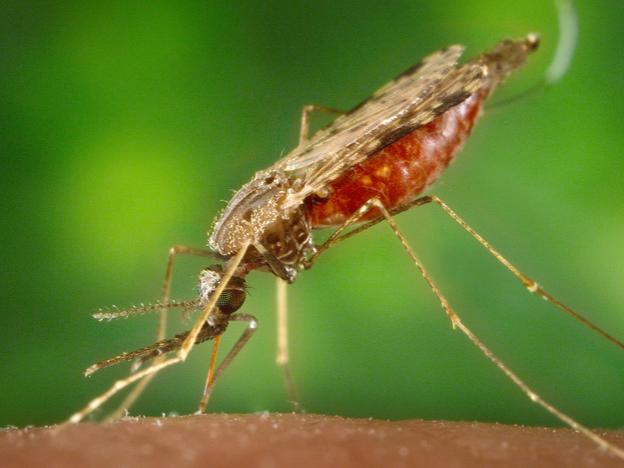
A new study by an international team that includes researchers from Penn State explores how a cancer drug currently in clinical trials could protect from, cure, and prevent transmission of malaria. Credit: U.S. Centers for Disease Control. All Rights Reserved.
研究チームは、乳癌、子宮内膜癌、膠芽腫、腎細胞癌、甲状腺癌など、様々な癌の治療に現在臨床試験中の薬、サパニセルティブが、マラリアの治療に使用できるかどうかを探った。
サパニセチブは、マラリア原虫が宿主の体内で生活するいくつかの段階で殺すことにより、マラリアから守り、治し、感染を阻止する可能性があることを発見した。この段階には、寄生虫が最初に成長・増殖する肝臓にいるとき、臨床症状が見られる宿主の赤血球内にいるとき、宿主の赤血球内で性的に分裂して伝達型の寄生虫を作り出すときが含まれる。伝達型は、通常、アノフェレス蚊の雌が血液を摂取する際に取り込まれ、その後の血液摂取で別の人に感染するため、寄生虫を殺すことでその後の感染も防ぐことができると考えられる。
また、サパニセルチブがヒトマラリア原虫を殺すメカニズムを解明し、この薬剤がマラリア原虫のキナーゼと呼ばれる複数のタンパク質を阻害することを明らかにした。
<関連情報>
- https://www.psu.edu/news/eberly-college-science/story/cancer-drug-could-potentially-be-used-against-malaria/
- https://www.science.org/doi/10.1126/scitranslmed.abo7219
抗がん剤ヒトmTOR阻害剤サパニセルティブは、複数の原虫のキナーゼとライフサイクルステージを強力に阻害する The anticancer human mTOR inhibitor sapanisertib potently inhibits multiple Plasmodium kinases and life cycle stages
Lauren B. Arendse ,James M. Murithi,Tarrick Qahash ,Charisse Flerida A. Pasaje,Luiz C. Godoy,Sumanta Dey,Liezl Gibhard,Sonja Ghidelli-Disse ,Gerard Drewes ,Marcus Bantscheff,Maria J. Lafuente-Monasterio,Stephen Fienberg,Lynn Wambua,Samuel Gachuhi ,Dina Coertzen,Mariëtte van der Watt,Janette Reader,Ayesha S. Aswat,Erica Erlank,Nelius Venter,Nimisha Mittal ,Madeline R. Luth ,Sabine Ottilie ,Elizabeth A. Winzeler,Lizette L. Koekemoer,Lyn-Marie Birkholtz ,Jacquin C. Niles,Manuel Llinás,David A. Fidock,Kelly Chibale
Science Translational Medicine Published:19 Oct 2022
DOI: 10.1126/scitranslmed.abo7219
Multistage antimalarial
Malaria is caused by infection with the protozoan parasite Plasmodium spp. and remains a serious global health threat. The emergence of resistance to existing antimalarial drugs highlights a need for treatments that use different mechanisms and target multiple parasite life stages. Arendse et al. show that the human mammalian target of rapamycin (mTOR) inhibitor sapanisertib has potent activity against liver and asexual blood stage Plasmodium spp. infection and can block parasite transmission from mosquitos. Sapanisertib is a pyrazolopyrimidine human kinase inhibitor that was initially developed to treat cancer. Chemoproteomic tools and biochemical assays revealed that sapanisertib can inhibit the Plasmodium kinases phosphatidylinositol 4-kinase type III beta (PI4Kβ) and cGMP-dependent protein kinase (PKG). These results highlight the potential of sapanisertib as a promising antimalarial with multistage activity and the ability to target at least two Plasmodium kinases.
Abstract
Compounds acting on multiple targets are critical to combating antimalarial drug resistance. Here, we report that the human “mammalian target of rapamycin” (mTOR) inhibitor sapanisertib has potent prophylactic liver stage activity, in vitro and in vivo asexual blood stage (ABS) activity, and transmission-blocking activity against the protozoan parasite Plasmodium spp. Chemoproteomics studies revealed multiple potential Plasmodium kinase targets, and potent inhibition of Plasmodium phosphatidylinositol 4-kinase type III beta (PI4Kβ) and cyclic guanosine monophosphate–dependent protein kinase (PKG) was confirmed in vitro. Conditional knockdown of PI4Kβ in ABS cultures modulated parasite sensitivity to sapanisertib, and laboratory-generated P. falciparum sapanisertib resistance was mediated by mutations in PI4Kβ. Parasite metabolomic perturbation profiles associated with sapanisertib and other known PI4Kβ and/or PKG inhibitors revealed similarities and differences between chemotypes, potentially caused by sapanisertib targeting multiple parasite kinases. The multistage activity of sapanisertib and its in vivo antimalarial efficacy, coupled with potent inhibition of at least two promising drug targets, provides an opportunity to reposition this pyrazolopyrimidine for malaria.