2025-06-24 東京大学
<関連情報>
- https://www.u-tokyo.ac.jp/focus/ja/press/z0406_00007.html
- https://www.u-tokyo.ac.jp/content/400266245.pdf
- https://www.nature.com/articles/s41467-025-60791-5
バロキサビル マルボキシルのウシH5N1ウイルスに対するマウスでの有効性 Efficacy of baloxavir marboxil against bovine H5N1 virus in mice
Maki Kiso,Ryuta Uraki,Seiya Yamayoshi & Yoshihiro Kawaoka
Nature Communications Published:20 June 2025
DOI:https://doi.org/10.1038/s41467-025-60791-5
Abstract
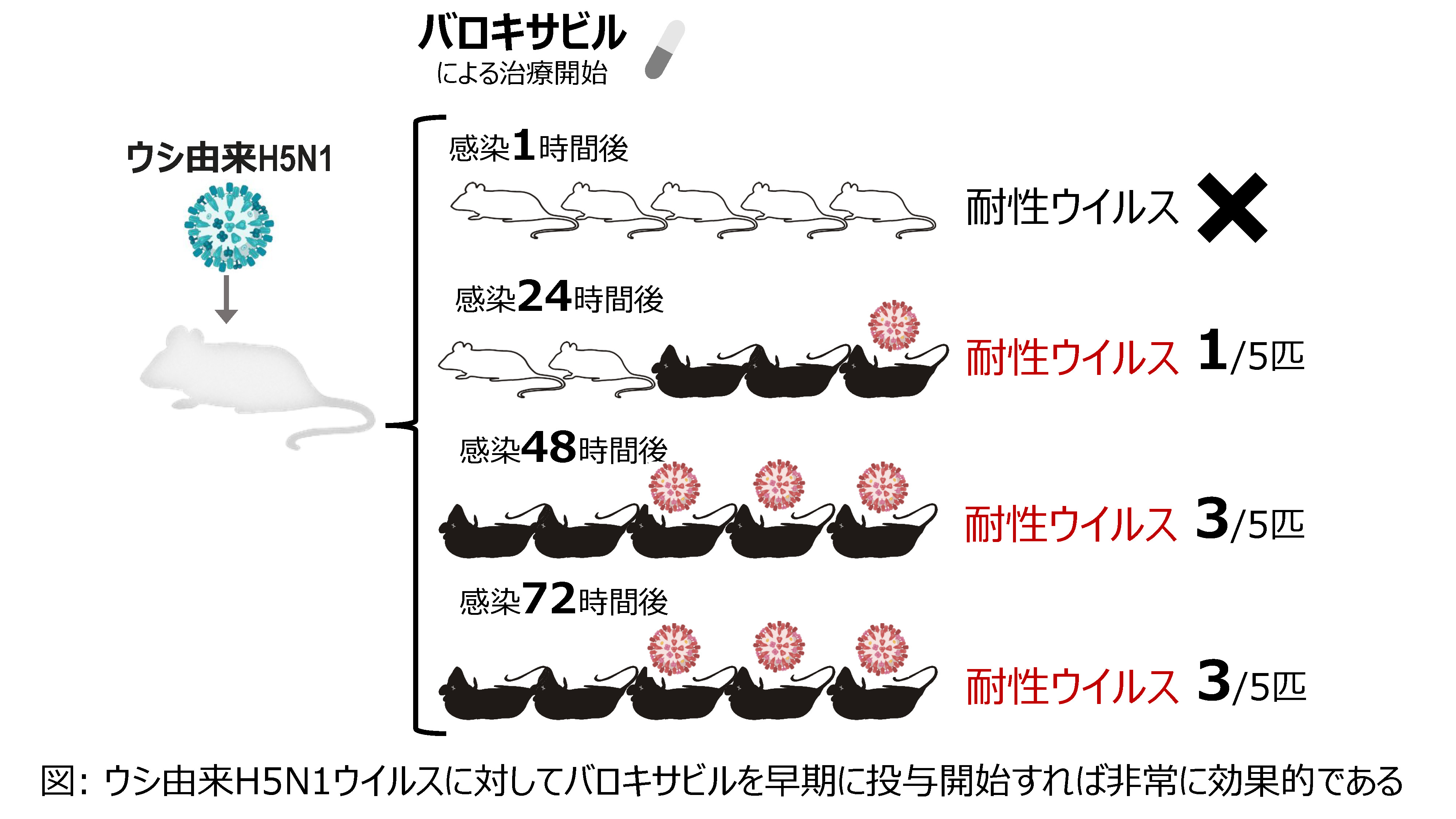
Since the first detection of highly pathogenic avian influenza (HPAI) H5N1 (clade 2.3.4.4b) in U.S. dairy cattle in early 2024, the virus has spread rapidly, posing a major public health concern as the number of human cases continues to rise. Although human-to-human transmission has not been confirmed, experimental data suggest that the bovine H5N1 virus can transmit via respiratory droplets in ferrets, highlighting its pandemic potential. With no vaccines currently available, antiviral drugs remain the only treatment option. Here, we investigate the efficacy of the polymerase inhibitor baloxavir marboxil (BXM) against this virus in mice. We find that early treatment post-infection is effective, but delayed treatment significantly reduces BXM efficacy and increases the risk of BXM resistance, underscoring the importance of timely BXM administration for effective treatment.