
2025-06-26 カリフォルニア大学バークレー校(UCB)
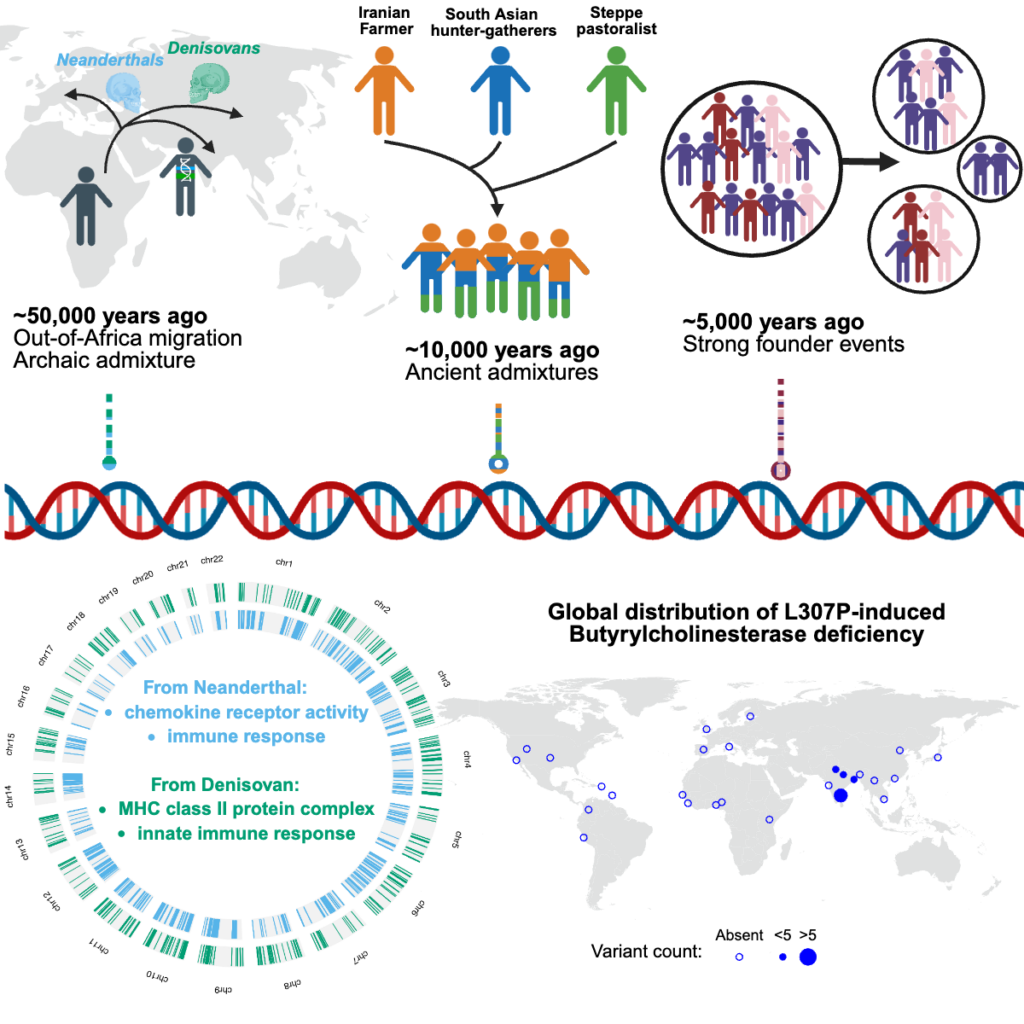 The new analysis traces Indian ancestry back to a migration out of Africa around 50,000 years ago, after which humans interbred with Neanderthals and Denisovans and then spread throughout Eurasia. Some genes acquired from those now-extinct ancestors affect immune response. About 10,000 years ago, there was an influx of farmers from Iran and nomadic herders from the Central Asian steppe to India, who mixed with the local hunter-gatherer. Then, 5,000 years ago, endogamy led to bottlenecks in many Indian communities. Together, this complex evolutionary history has shaped the genetic variation and health and disease in India.
<関連情報>
- https://news.berkeley.edu/2025/06/26/scientists-complete-the-most-thorough-analysis-yet-of-indias-genetic-diversity/
- https://www.cell.com/cell/fulltext/S0092-8674(25)00462-3
インド5万年の進化の歴史: 健康と疾病の変動への影響 50,000 years of evolutionary history of India: Impact on health and disease variation
Elise Kerdoncuff ∙ Laurits Skov ∙ Nick Patterson ∙ … ∙ Sharon L.R. Kardia ∙ Jinkook Lee ∙ Priya Moorjani
Cell Accepted: April 21, 2025
DOI:https://doi.org/10.1016/j.cell.2025.04.027
Highlights
•Insights into Indian genetic variation from ∼2,700 whole-genome sequences
•Identification of source of Iranian farmer-related ancestry in India
•Characterization of Neanderthal and Denisovan ancestry in India
•Discovery of population-specific and disease susceptibility variants in India
Summary
India has been underrepresented in genomic surveys. We generated whole-genome sequences from 2,762 individuals in India, capturing the genetic diversity across most geographic regions, linguistic groups, and historically underrepresented communities. We find most Indians harbor ancestry primarily from three ancestral groups: South Asian hunter-gatherers, Eurasian Steppe pastoralists, and Neolithic farmers related to Iranian and Central Asian cultures. The extensive homozygosity and identity-by-descent sharing among individuals reflects strong founder events due to a recent shift toward endogamy. We uncover that most of the genetic variation in Indians stems from a single major migration out of Africa that occurred around 50,000 years ago, followed by 1%–2% gene flow from Neanderthals and Denisovans. Notably, Indians exhibit the largest variation and possess the highest amount of population-specific Neanderthal ancestry segments among worldwide groups. Finally, we discuss how this complex evolutionary history has shaped the functional and disease variation on the subcontinent.

