
2025-06-30 カリフォルニア工科大学(Caltech)
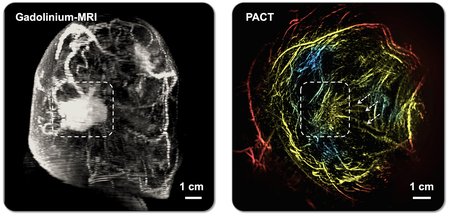
Contrast-enhanced magnetic resonance imaging (MRI, left) and non-invasive photoacoustic computed tomography (PACT, right) of the same breast with invasive ductal carcinoma. PACT reveals more feeding vessels compared to MRI, as indicated by dashed arrows.Credit: Xin Tong/Caltech Optical Imaging Laboratory
<関連情報>
- https://www.caltech.edu/about/news/ai-assisted-technique-offers-safe-effective-painless-breast-imaging-alternative
- https://www.nature.com/articles/s41551-025-01435-3
- https://authors.library.caltech.edu/records/z16qg-pd091
学習ベースの分類を用いたパノラマ光音響コンピュータ断層撮影が乳房病変の特徴付けを強化する Panoramic photoacoustic computed tomography with learning-based classification enhances breast lesion characterization
Xin Tong,Cindy Z. Liu,Yilin Luo,Li Lin,Jessica Dzubnar,Marta Invernizzi,Stephanie Delos Santos,Yide Zhang,Rui Cao,Peng Hu,Junfu Zheng,Jaclene Torres,Armine Kasabyan,Lily L. Lai,Lisa D. Yee & Lihong V. Wang
Nature Biomedical Engineering Published:24 June 2025
DOI:https://doi.org/10.1038/s41551-025-01435-3
Abstract
Breast cancer diagnosis is crucial due to the high prevalence and mortality rate associated with the disease. However, mammography involves ionizing radiation and has compromised sensitivity in radiographically dense breasts, ultrasonography lacks specificity and has operator-dependent image quality, and magnetic resonance imaging faces high cost and patient exclusion. Photoacoustic computed tomography (PACT) offers a promising solution by combining light and ultrasound for high-resolution imaging that detects tumour-related vasculature changes. Here we introduce a workflow using panoramic PACT for breast lesion characterization, offering detailed visualization of vasculature irrespective of breast density. Analysing PACT features of 78 breasts in 39 patients, we develop learning-based classifiers to distinguish between normal and suspicious tissue, achieving a maximum area under the receiver operating characteristic curve of 0.89, which is comparable with that of conventional imaging standards. We further differentiate malignant and benign lesions using 13 features. Finally, we developed a learning-based model to segment breast lesions. Our study identifies PACT as a non-invasive and sensitive imaging tool for breast lesion evaluation.
乳房の単一呼吸保持型光音響コンピュータ断層撮影 Single-breath-hold photoacoustic computed tomography of the breast
Li Lin,Peng Hu,Junhui Shi,Catherine M. Appleton,Konstantin Maslov,Lei Li,Ruiying Zhang & Lihong V. Wang
Nature Communications Published:15 June 2018
DOI:https://doi.org/10.1038/s41467-018-04576-z
Abstract
We have developed a single-breath-hold photoacoustic computed tomography (SBH-PACT) system to reveal detailed angiographic structures in human breasts. SBH-PACT features a deep penetration depth (4 cm in vivo) with high spatial and temporal resolutions (255 µm in-plane resolution and a 10 Hz 2D frame rate). By scanning the entire breast within a single breath hold (~15 s), a volumetric image can be acquired and subsequently reconstructed utilizing 3D back-projection with negligible breathing-induced motion artifacts. SBH-PACT clearly reveals tumors by observing higher blood vessel densities associated with tumors at high spatial resolution, showing early promise for high sensitivity in radiographically dense breasts. In addition to blood vessel imaging, the high imaging speed enables dynamic studies, such as photoacoustic elastography, which identifies tumors by showing less compliance. We imaged breast cancer patients with breast sizes ranging from B cup to DD cup, and skin pigmentations ranging from light to dark. SBH-PACT identified all the tumors without resorting to ionizing radiation or exogenous contrast, posing no health risks.

