
2025-07-01 カリフォルニア大学リバーサイド校(UCR)
<関連情報>
- https://news.ucr.edu/articles/2025/07/01/sugar-hidden-thermostat-plants
- https://www.nature.com/articles/s41467-025-60498-7
シロイヌナズナにおける日中の温度形態形成を引き起こすマルチセンサー高温シグナル伝達フレームワーク A multisensor high-temperature signaling framework for triggering daytime thermomorphogenesis in Arabidopsis
De Fan,Wei Hu,Nan Xu,Ethan R. Seto,John Clark Lagarias,Xuemei Chen & Meng Chen
Nature Communications Published:04 June 2025
DOI:https://doi.org/10.1038/s41467-025-60498-7
Abstract
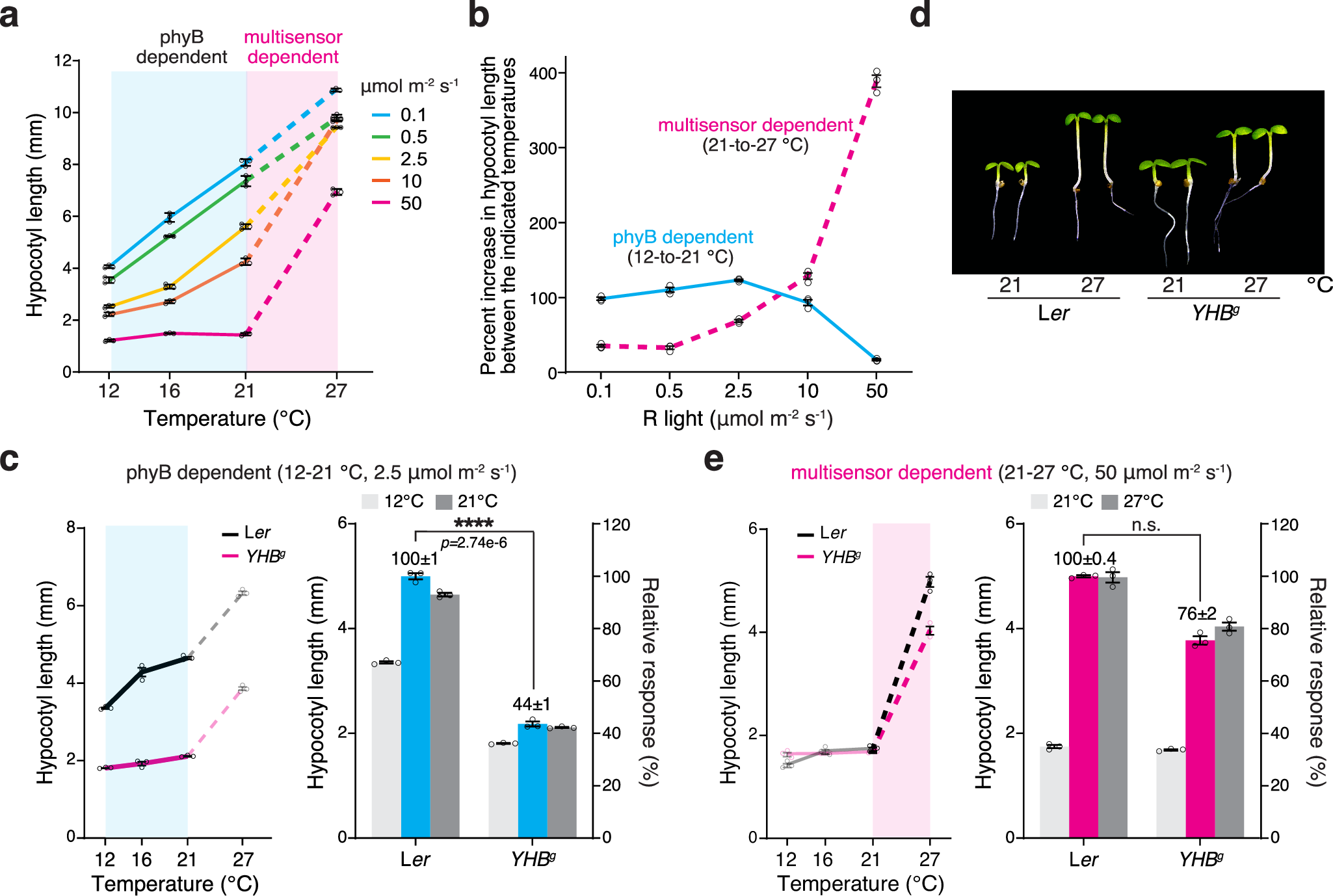
The phytochrome B (phyB) photoreceptor and EARLY FLOWERING 3 (ELF3) are two major plant thermosensors that monitor high temperatures primarily at night. However, high temperatures naturally occur during the daytime; the mechanism of daytime thermosensing and whether these thermosensors can also operate under intense sunlight remain ambiguous. Here, we show that phyB plays a substantial role in daytime thermosensing in Arabidopsis, and its thermosensing function becomes negligible only when the red light intensity reaches 50 μmol m-2 s-1. Leveraging this restrictive condition for phyB thermosensing, we reveal that triggering daytime thermomorphogenesis requires two additional thermosensory pathways. High temperatures induce starch breakdown in chloroplasts and the production of sucrose, which stabilizes the central thermal regulator PHYTOCHROME-INTERACTING FACTOR 4 (PIF4) by antagonizing phyB-dependent PIF4 degradation. In parallel, high temperatures release the inhibition of PIF4 transcription and PIF4 activity by ELF3. Thus, our study elucidates a multisensor high-temperature signaling framework for understanding diverse thermo-inducible plant behaviors in daylight.

