2025-07-01 マサチューセッツ工科大学 (MIT)
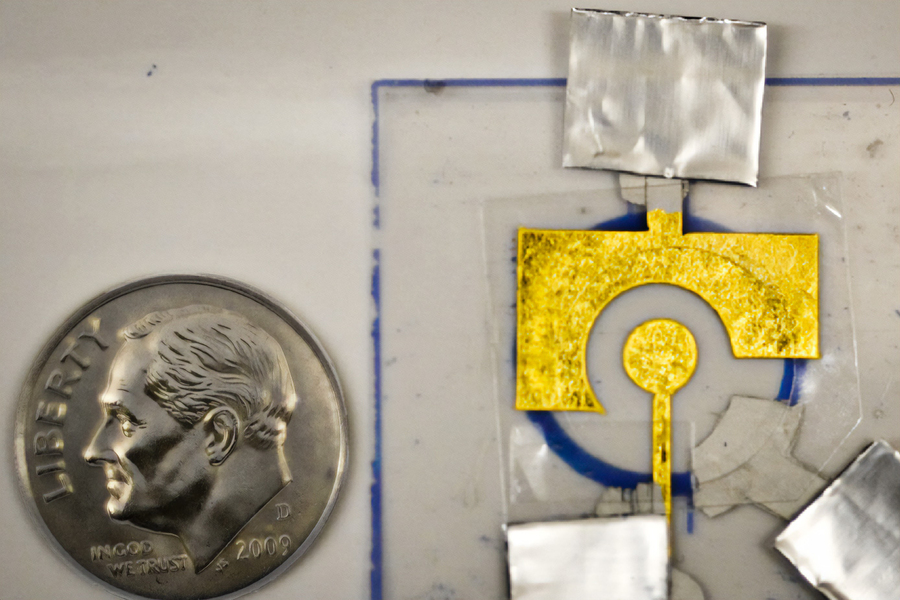
The electrochemical sensors developed in Ariel Furst’s lab consist of DNA adhered to an inexpensive gold leaf electrode, which is laminated onto a sheet of plastic. Credit: Courtesy of the researchers; edited by MIT News
<関連情報>
- https://news.mit.edu/2025/mit-engineers-develop-electrochemical-sensors-cheap-disposable-diagnostics-0701
- https://pubs.acs.org/doi/10.1021/acssensors.5c00937
固定化DNAの長期保存のためのポリマーコーティング Polymer Coating for the Long-Term Storage of Immobilized DNA
Xingcheng ZhouJessica SlaughterSmah RikiChao Chi KuoAriel Furst
ACS Sensors Published: June 30, 2025
DOI:https://doi.org/10.1021/acssensors.5c00937
Abstract
As healthcare systems worldwide demand early disease detection and personalized medicine, electrochemical biosensors stand out as a promising technology to meet these demands due to their sensitivity, selectivity, and rapid response. Specifically, DNA-based electrochemical biosensors are versatile and have been used to identify biomarkers of various infectious diseases. However, there is a significant gap between laboratory-scale proof-of-concept systems and commercially viable technologies. Commercialization of such sensors faces many challenges, with one of the most important being the stability and shelf life of the immobilized DNA. Surface-associated DNA faces thermal degradation, structural changes, and oxidation of tethering thiol groups, which causes DNA stripping from the surface. Currently, technology to support the long-term storage of these sensors at ambient temperatures is limited. Here, we report a novel method to preserve DNA in electrochemical biosensors through the application of a protective coating of poly(vinyl alcohol) (PVA). We show that with our PVA coating, the shelf life of dried, DNA-functionalized electrodes at ambient temperature is a minimum of 2 months. We further demonstrate that the protective capabilities of PVA extend to temperatures as high as 65 °C and that the biological relevance of the assay is not impacted by the coating. Our simple approach to DNA protection supports our understanding of how the electrode interfaces with biomolecules and facilitates biosensor scaling and commercialization.