2025-07-10 トロント大学
<関連情報>
- https://www.utoronto.ca/news/intermittent-fasting-effective-weight-loss-traditional-dieting-study
- https://www.bmj.com/content/389/bmj-2024-082007
間欠的絶食戦略と体重およびその他の心代謝リスク因子に対するそれらの効果:無作為化臨床試験の系統的レビューおよびネットワークメタ解析 Intermittent fasting strategies and their effects on body weight and other cardiometabolic risk factors: systematic review and network meta-analysis of randomised clinical trials
Zhila Semnani-Azad, postdoctoral fellow,Tauseef A Khan, senior research scientist,Laura Chiavaroli, assistant professor,Victoria Chen, research assistant,Hardil Anup Bhatt, resident physician,Alisia Chen, resident physician,Nicholas Chiang, resident physician,Julianah Oguntala, resident physician,Stefan Kabisch, physician,David CW Lau, professor and physician,Sean Wharton, professor and physician,Arya M Sharma, professor,Leanne Harris, scientist,Lawrence A Leiter, professor and physician,James O Hill, professor,Frank B Hu, professor,Michael EJ Lean, professor and physician,Hana Kahleová, physician,Dario Rahelic, associate professor and physician,Jordi Salas-Salvadó, professor,Cyril WC Kendall, senior research associate,John L Sievenpiper, professor and physician
The BMJ Published:18 June 2025
DOI:https://doi.org/10.1136/bmj-2024-082007
Abstract
Objective
To assess the effect of intermittent fasting diets, with continuous energy restriction or unrestricted (ad-libitum) diets on intermediate cardiometabolic outcomes from randomised clinical trials.
Design
Systematic review and network meta-analysis.
Data sources
Medline, Embase, and central databases from inception to 14 November 2024.
Eligibility criteria for selecting studies
Randomised clinical trials comparing the association of intermittent fasting diets (alternate day fasting, time restricted eating, and whole day fasting), continuous energy restriction, and ad-libitum diets were included.
Main outcomes
Outcomes included body weight (primary) and measures of anthropometry, glucose metabolism, lipid profiles, blood pressure, C-reactive protein, and markers of liver disease.
Data synthesis
A network meta-analysis based on a frequentist framework was performed with data expressed as mean difference with 95% confidence intervals (CIs). The certainty of the evidence was assessed using grading of recommendations assessment, development, and evaluation (GRADE).
Results
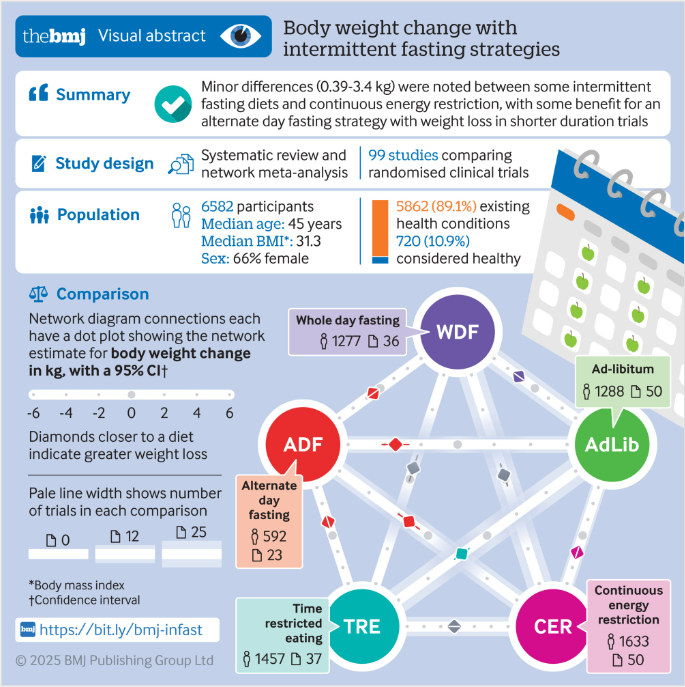
99 randomised clinical trials involving 6582 adults of varying health conditions (720 healthy, 5862 existing health conditions) were identified. All intermittent fasting and continuous energy restriction diet strategies reduced body weight when compared with ad-libitum diet. Compared with continuous energy restriction, alternate day fasting was the only form of intermittent fasting diet strategy to show benefit in body weight reduction (mean difference -1.29 kg (95% CI -1.99 to -0.59), moderate certainty of evidence). Additionally, alternate day fasting showed a trivial reduction in body weight compared with both time restricted eating and whole day fasting (mean difference -1.69 kg (-2.49 to -0.88) and -1.05 kg (-1.90 to -0.19), respectively, both with moderate certainty of evidence). Estimates were similar among trials with less than 24 weeks follow-up (n=76); however, moderate-to-long-term trials (≥24 weeks, n=17) only showed benefits in weight reduction in diet strategies compared with ad-libitum. Furthermore, in comparisons between intermittent fasting strategies, alternate day fasting lowered total cholesterol, triglycerides, and non-high density lipoprotein compared with time restricted eating. Compared with whole day fasting, however, time restricted eating resulted in a small increase in total cholesterol, low density lipoprotein cholesterol, and non-high density lipoprotein cholesterol. No differences were noted between intermittent fasting, continuous energy restriction, and ad-libitum diets for HbA1c and high density lipoprotein.
Conclusions
Minor differences were noted between some intermittent fasting diets and continuous energy restriction, with some benefit of weight loss with alternate day fasting in shorter duration trials. The current evidence provides some indication that intermittent fasting diets have similar benefits to continuous energy restriction for weight loss and cardiometabolic risk factors. Longer duration trials are needed to further substantiate these findings.
Trial registration
ClinicalTrials.gov NCT05309057.