2025-07-15 オックスフォード大学
<関連情報>
- https://www.ox.ac.uk/news/2025-07-15-past-their-prime-tool-use-declines-age-wild-chimpanzees
- https://elifesciences.org/articles/105411
高齢化がチンパンジーの石器使用における関与と効率に様々な影響を与える Old age variably impacts chimpanzee engagement and efficiency in stone tool use
Elliot Howard-Spink,Tetsuro Matsuzawa,Susana Carvalho,Catherine Hobaiter,Katarina Almeida-Warren,Thibaud Gruber,Dora Biro
eLife Published:Jul 15, 2025
DOI:https://doi.org/10.7554/eLife.105411.3
Abstract
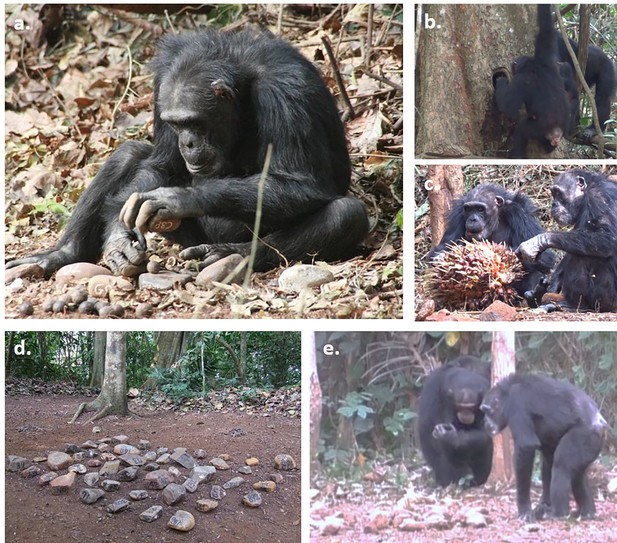
We know vanishingly little about how long-lived apes experience senescence in the wild, particularly with respect to their foraging behaviors. Chimpanzees use tools during foraging, and given the cognitive and physical challenges presented by tool use, tool-use behaviors are potentially at a heightened risk of senescence, though this has never been investigated in wild individuals. Accordingly, we sampled data from a longitudinal video archive that contained footage of wild chimpanzees using stone hammers and anvils to crack hard-shelled nuts (nut cracking) at an ‘outdoor laboratory’ over a 17-year period (with focal chimpanzees aging from approximately 39–44 to 56–61 years across this period). Over time, elderly chimpanzees began attending experimental nut-cracking sites less frequently than younger individuals. Several elderly chimpanzees exhibited reductions in efficiency across multiple stages of nut cracking, including taking longer to both select stone tools prior to use and use tools to crack open nuts and consume the associated pieces of kernel. Two chimpanzees began using less streamlined behavioral sequences to crack nuts, including a greater number of actions (such as more numerous hammer strikes). Notably, we report interindividual variability in the extent to which elderly chimpanzees’ tool-use behaviors changed during our sample period – ranging from small to profound reductions in engagement and efficiency – as well as differences in the specific aspects of nut cracking that changed for each individual. We discuss the possible causes of these changes – and recommendations for future research – with reference to literature surrounding the senescence of captive and wild primates.