2025-07-30 国立遺伝学研究所
<関連情報>
- https://www.nig.ac.jp/nig/ja/2025/07/research-highlights_ja/pr20250723.html
- https://www.pnas.org/doi/10.1073/pnas.2513676122
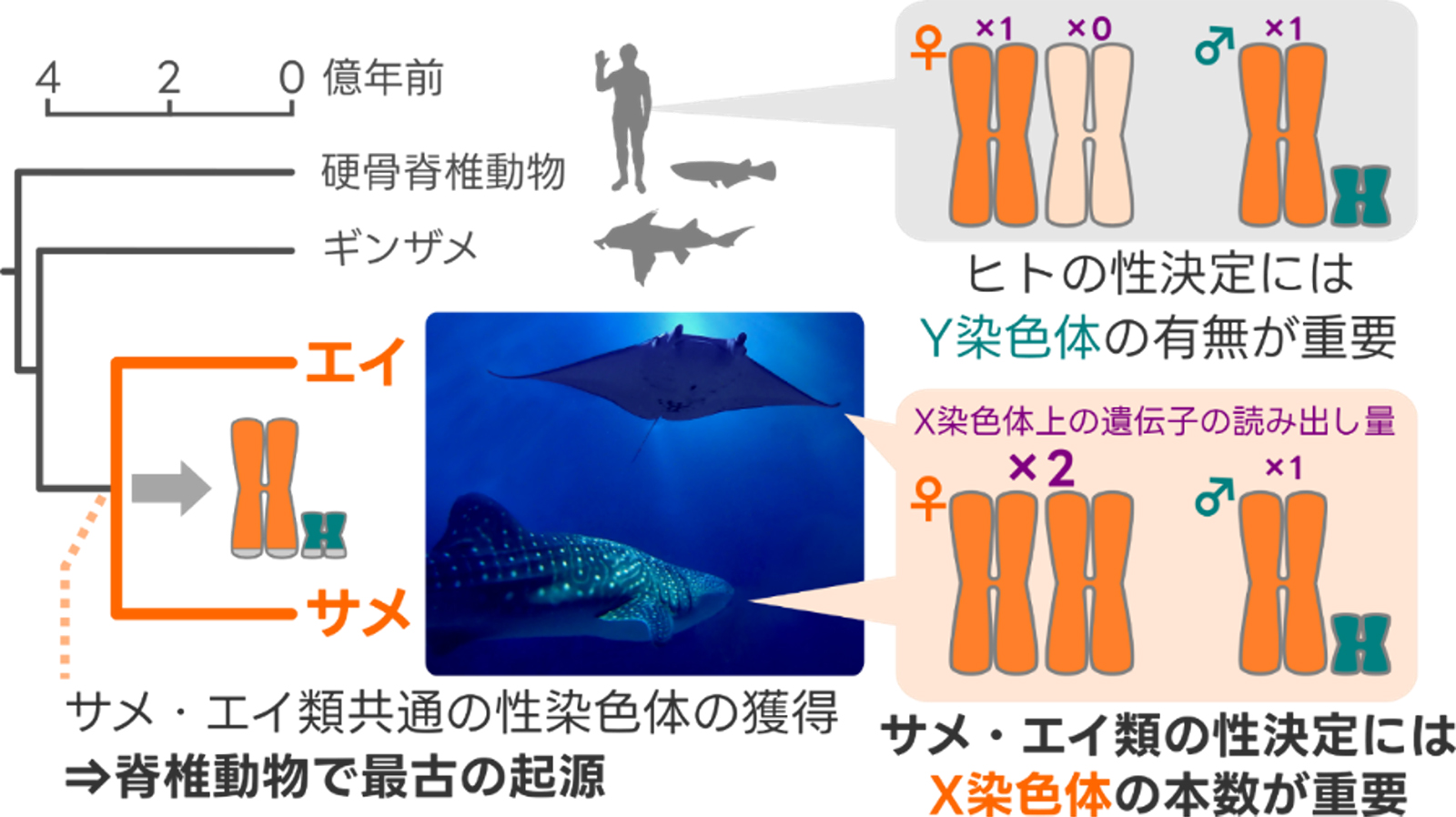
サメとエイは、独自の性決定メカニズムを有する最古の脊椎動物の性染色体を有する Sharks and rays have the oldest vertebrate sex chromosome with unique sex determination mechanisms
Taiki Niwa, Yoshinobu Uno, Yuta Ohishi, +9 , and Shigehiro Kuraku
Proceedings of the National Academy of Sciences Published:July 22, 2025
DOI:https://doi.org/10.1073/pnas.2513676122
Significance
Sex chromosomes evolve differently across vertebrate lineages. Mammals and birds have sustained them for around one hundred million years, while teleost fishes have frequently reestablished them. These systems were underpinned by diverse sex-determining genes with various molecular functions, raising questions about how these diverse systems evolved. Here, we delved into sex chromosome evolution in cartilaginous fishes, which remained unexplored despite their crucial phylogenetic position in vertebrates. Our analyses provided an overview of their sex determination: sharks and rays share the oldest vertebrate sex chromosomes, dating back approximately 300 My, and employ unique sex determination mechanisms composed of distinct molecules from other vertebrates. This study enhances our understanding of evolutionary plasticity in vertebrate sex determination.
Abstract
Sex determination has been investigated across vertebrate lineages to reveal the stepwise evolution of sex chromosomes and the diversity of responsible molecular mechanisms. However, these studies rarely include cartilaginous fishes, which diverged from the other vertebrates 450 Mya, hindering the comprehensive view of vertebrate sex determination. Here, we produced chromosome-scale genome assemblies of egg-laying shark species and comparatively investigated genome sequences and transcriptome profiles across diverse cartilaginous fishes. Sex chromosome identification, supported by cytogenetic experiments, elucidated the homology of X chromosomes between sharks and rays as well as an extensively degenerated Y chromosome harboring no detectable male-specific genes. Orthologs of documented sex-determining genes were identified, but not on these sex chromosomes. Transcriptomic analyses combined with histology of embryonic gonads revealed female-biased expression of X-linked genes—including those implicated in the TGF-β and IGF signaling pathways—attributed to incomplete dosage compensation. Our findings indicate that sharks and rays share the oldest sex chromosomes among vertebrates that originated around 300 Mya and the dosage-dependent sex determination mechanism composed of distinct molecules from other vertebrates. This study highlights the antiquity of sex chromosomes and the uniqueness of sex determination mechanisms in sharks and rays, which advances our understanding of evolutionary plasticity in vertebrate sex determination.