
2025-08-01 シカゴ大学(UChicago)
<関連情報>
- https://news.uchicago.edu/story/new-research-charts-sharp-global-rise-inflammatory-bowel-disease
- https://www.nature.com/articles/s41586-025-08940-0
疫学段階における炎症性腸疾患のグローバルな進化 Global evolution of inflammatory bowel disease across epidemiologic stages
Lindsay Hracs,Joseph W. Windsor,Julia Gorospe,Michael Cummings,Stephanie Coward,Michael J. Buie,Joshua Quan,Quinn Goddard,Léa Caplan,Ante Markovinović,Tyler Williamson,Yvonne Abbey,Murdani Abdullah,Maria T. Abreu,Vineet Ahuja,Raja Affendi Raja Ali,Mansour Altuwaijri,Domingo Balderramo,Rupa Banerjee,Eric I. Benchimol,Charles N. Bernstein,Eduard Brunet-Mas,Johan Burisch,Vui Heng Chong,Global IBD Visualization of Epidemiology Studies in the 21st Century (GIVES-21) Research Group
Nature Published:30 April 2025
DOI:https://doi.org/10.1038/s41586-025-08940-0
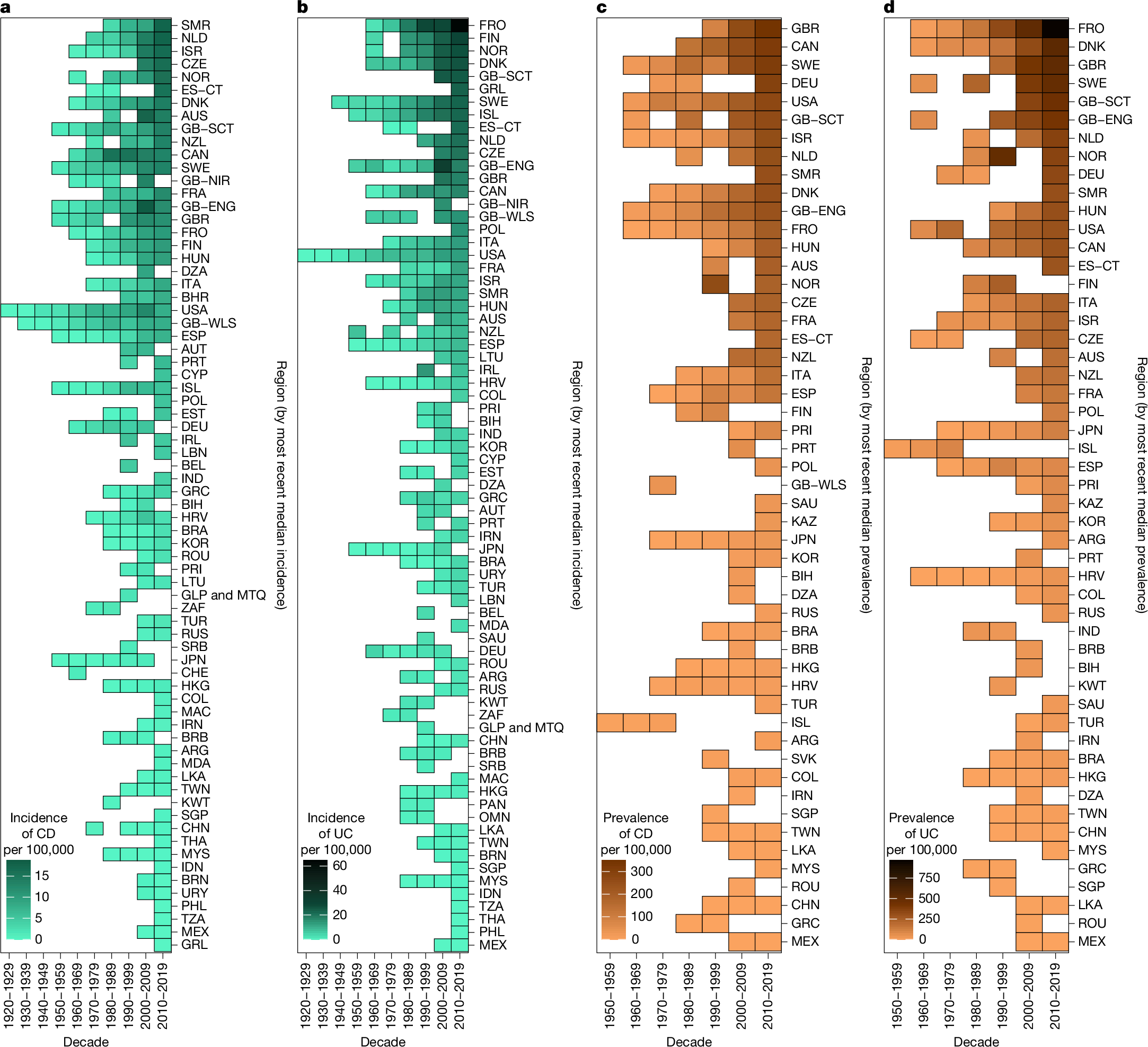
Abstract
During the twentieth century, inflammatory bowel disease (IBD) was considered a disease of early industrialized regions in North America, Europe and Oceania1. At the turn of the twenty-first century, IBD incidence increased in newly industrialized and emerging regions in Africa, Asia and Latin America, while the prevalence in early industrialized regions continued to grow steadily2,3,4. Changes in the incidence and prevalence denote the evolution of IBD across four epidemiologic stages: stage 1 (emergence), characterized by low incidence and prevalence; stage 2 (acceleration in incidence), marked by rapidly rising incidence and low prevalence; and stage 3 (compounding prevalence), where the incidence decelerates, plateaus or declines while the prevalence steadily increases. A fourth stage (prevalence equilibrium) has been proposed in which the prevalence slope plateaus due to demographic shifts in an ageing IBD population, but it has not yet been evidenced. To date, these stages have remained theoretical, lacking specific numerical indicators to define transition points. Here, using real-world data from 522 population-based studies encompassing 82 global regions and spanning more than a century (1920–2024), we show spatiotemporal transitions across stages 1–3 and model stage 4 progression. Understanding the evolution of IBD across epidemiologic stages enables healthcare systems to better anticipate the future worldwide burden of IBD.

