
2025-07-30 中国科学院(CAS)
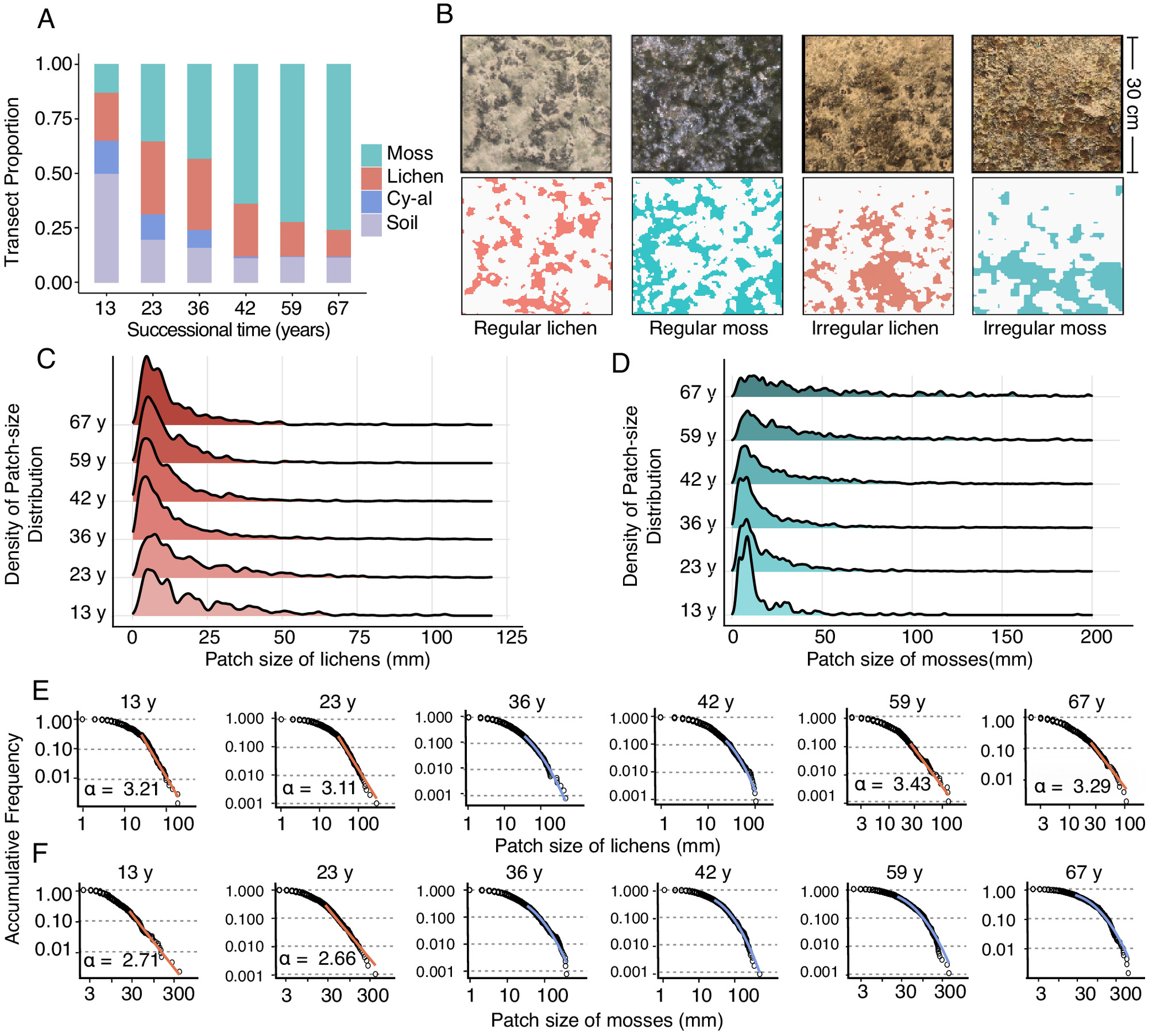
Change of composition and patch size distribution of biocrusts along successional gradient (Image by NIEER)
<関連情報>
- https://english.cas.cn/newsroom/research_news/earth/202508/t20250801_1048950.shtml
- https://www.pnas.org/doi/10.1073/pnas.2424836122
乾燥地帯におけるバイオクラストの動力学は、空間的・時間的スケール依存性フィードバックによって支配される Spatial and temporal scale–dependent feedbacks govern dynamics of biocrusts in drylands
Jingyao Sun, Kailiang Yu, Max Rietkerk, +3 , and Xinrong Li
Proceedings of the National Academy of Sciences Published:July 21, 2025
DOI:https://doi.org/10.1073/pnas.2424836122
Significance
An intriguing phenomenon is the capability of biota to form striking self-organized spatial patterns. Biocrusts serve as the soil’s skin and have different morphology and life history as compared to plant communities. We investigated these distinct self-organized spatial patterns exhibited by mosaic patches of mosses and lichens across succession stages through field surveys and a probabilistic cellular automaton (CA) model. Our results provide empirical evidence that biocrusts act as ecosystem engineers, forming self-organized spatial patterns. Simulations and field measurements of biocrust performance elucidate the mechanism of spatial and temporal scale–dependent feedbacks in governing biocrust spatial pattern formation. This self-organizing ability of biocrusts holds significant implications for ecosystem functions and the resilience of dryland ecosystems.
Abstract
Biota could be ecosystem engineers in generating an intrinsic heterogeneous landscape through scale-dependent feedbacks. Thereby, they can form resource-enriched patchiness or islands of fertility, comprising self-organizing spatial patterns. Research so far has largely focused on the self-organized spatial patterns of plant communities in drylands. It, however, remains unclear whether and how biocrusts having distinct morphology and life history from plant communities could self-organize themselves and form unique spatial patterns. Here, we conducted field observations of biocrusts across successional stages and employed a probabilistic cellular automaton model to investigate the distinct self-organized spatial patterns exhibited by mosaic patches of mosses and lichens with different patch size distributions (PSDs). Our study demonstrates that short-range positive feedbacks initially promote the development of patches, featured with a heavy-tailed PSD, while long-range negative feedbacks subsequently curtail further expansion of big patches, thereby establishing a characteristic patch scale with regular PSDs. Strikingly, only lichens reverted back to the heavy-tailed PSD in the late succession stage, presumably implying self-organized critical fragmentation of lichen patches. Field measurements of biocrust performance at the center and edge of patches of varying sizes along succession stages further support the classic scale-dependent feedback mechanism for Turing pattern formation. Collectively, our results clearly demonstrate the capability of the biocrust communities to self-organize themselves to form distinct spatial patterns governed by the spatial and temporal scale–dependent feedbacks, potentially impacting dryland ecosystem functions and resilience.

