
2025-08-06 カリフォルニア工科大学(Caltech)
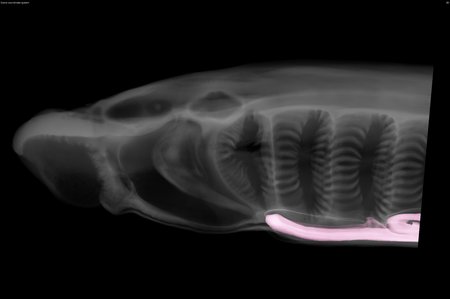
A scan of a larval-stage lamprey with endostyle highlighted in pink. The endostyle develops into the thyroid as the lamprey undergoes its maturation process.Credit: J. Stundl
<関連情報>
- https://www.caltech.edu/about/news/how-a-jawless-vertebrate-parasite-reveals-evolutionary-origins-of-the-thyroid
- https://www.science.org/doi/10.1126/sciadv.adv2657
神経堤の獲得が脊索動物のエンドスタイルから甲状腺の進化を促進した Acquisition of neural crest promoted thyroid evolution from chordate endostyle
Jan Stundl, Ayyappa Raja Desingu Rajan, Hugo A. Urrutia, Jake Leyhr, […] , and Marianne E. Bronner
Science Advances Published:6 Aug 2025
DOI:https://doi.org/10.1126/sciadv.adv2657
Abstract
The endostyle is an endodermal organ unique to nonvertebrate chordates except for lamprey larvae, where it serves as forerunner to the adult thyroid. Here, we examine whether the acquisition of neural crest in the vertebrate lineage played a role in the elaboration of the endostyle. CM-DiI lineage tracing reveals a neural crest contribution to the endostyle, and CRISPR-Cas9 mutagenesis of key neural crest genes causes endostyle defects including formation of a single rather than bilobed structure. RNA sequencing reveals gene profiles characteristic of embryonic neural crest cells and Schwann cell precursors in the developing endostyle. Contrasting with the prevailing view that the endostyle is an endoderm-derived organ, we propose that the acquisition of the neural crest played a critical step in promoting thyroid evolution from chordate endostyle.

