2025-08-14 カロリンスカ研究所(KI)
<関連情報>
- https://news.ki.se/covid-19-linked-to-increased-asthma-risk-vaccine-offers-protection
- https://www.jacionline.org/article/S0091-6749(25)00858-9/fulltext
- https://www.jacionline.org/article/S0091-6749(25)00858-9/pdf
COVID-19感染は呼吸器系2型炎症性疾患のリスクを高める一方、ワクチン接種は保護効果を示す COVID-19 infection raises respiratory type-2 inflammatory disease risk, whereas vaccination is protective
Henning Olbrich, MD ∙ Sophie L. Preuß, MD ∙ Khalaf Kridin, MD, PhD ∙ … ∙ Diamant Thaçi, MD ∙ Ralf J. Ludwig, MD ∙ Philip Curman, MD, PhD
The Journal of Allergy and Clinical Immunology Published:August 12, 2025
DOI:https://doi.org/10.1016/j.jaci.2025.07.030
ABSTRACT
Background
COVID-19 infection and vaccination have unclear impacts on type-2 inflammatory diseases. Although viral infections can drive immune dysregulation, the extent to which COVID-19 infection and vaccination affect type-2 inflammatory diseases in various organ systems remains underexplored.
Objective
We aimed to assess the risk of new-onset type-2 inflammatory diseases after COVID-19 infection and vaccination.
Methods
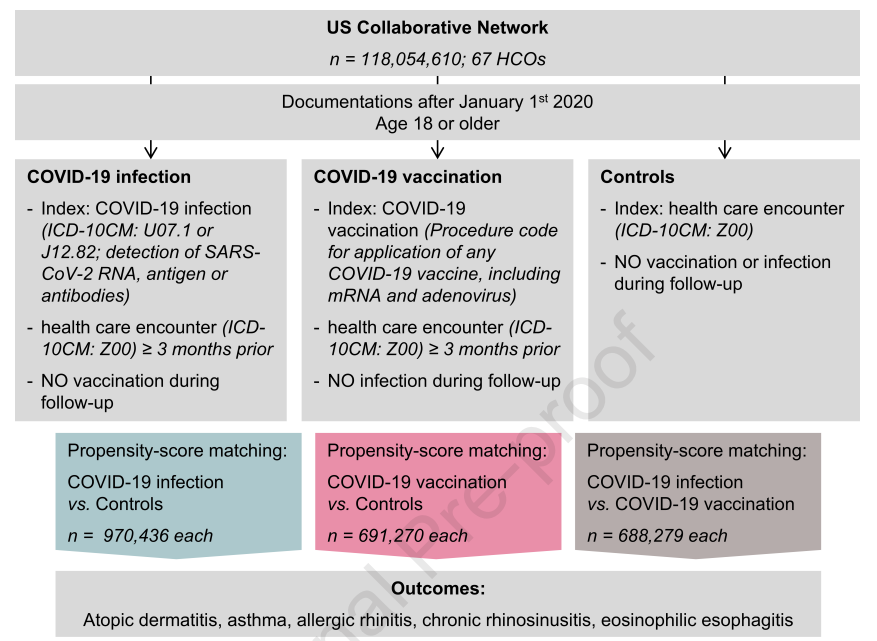
We conducted a large-scale retrospective matched cohort study within a United States electronic health records database of over 118 million patients. Three cohorts were defined: individuals with COVID-19 infection (973,794), individuals with COVID-19 vaccination (691,270), and unexposed controls (4,388,409). Propensity-score matching balanced demographic and clinical covariates. We calculated hazard ratios for incident asthma, allergic rhinitis, chronic rhinosinusitis, atopic dermatitis, and eosinophilic esophagitis over a three-month follow-up.
Results
COVID-19 infection significantly increased the risks of asthma (hazard ratio 1.656, 95% confidence interval 1.590–1.725), allergic rhinitis (1.272, 1.214–1.333), and chronic rhinosinusitis (1.744, 1.671–1.821). Risks for atopic dermatitis or eosinophilic esophagitis remained unchanged. In contrast, vaccination lowered the risks of asthma (0.678, 0.636–0.722) and chronic rhinosinusitis (0.799, 0.752–0.850). Direct comparison showed a two- to threefold greater risk of respiratory type-2 inflammatory diseases with infection than with vaccination.
Conclusion
COVID-19 infection is associated with a heightened risk of respiratory type-2 inflammatory diseases, whereas vaccination appears protective.
Clinical Implication
COVID-19 vaccination may reduce respiratory complications driven by type-2 inflammation, thereby diminishing disease burden.