2025-08-20 ペンシルベニア州立大学(PennState)
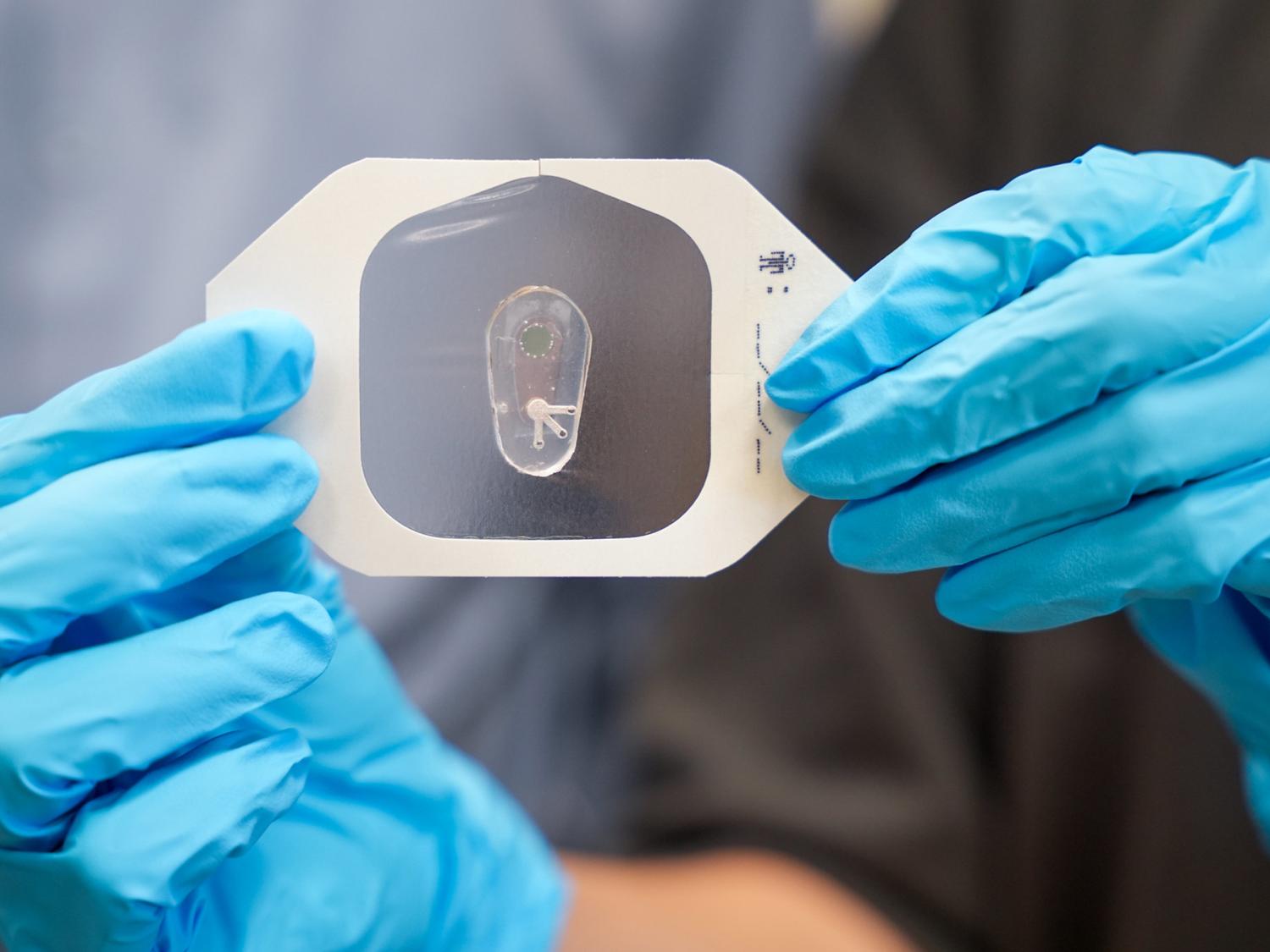 The team’s sensor is capable of measuring and reporting the chloride ion levels of a subject’s sweat in real time with high precision and efficiency. Credit: Caleb Craig/Penn State. All Rights Reserved.
<関連情報>
- https://www.psu.edu/news/engineering/story/breaking-sweat-using-chloride-sweat-help-diagnose-cystic-fibrosis
- https://www.sciencedirect.com/science/article/abs/pii/S0956566325006815
- https://medibio.tiisys.com/127615/
- https://medibio.tiisys.com/120814/
高感度で低ヒステリシスを有するハイドロゲルベースの汗塩化物センサー Hydrogel-based sweat chloride sensor with high sensitivity and low hysteresis
Wanqing Zhang, Xianzhe Zhang, Ankan Dutta, Farnaz Lorestani, Md Abu Sayeed Biswas, Bowen Li, Abu Musa Abdullah, Huanyu Cheng
Biosensors and Bioelectronics Available online: 24 July 2025
DOI:https://doi.org/10.1016/j.bios.2025.117805
Highlights
- Hydrogel-based wearable sensor achieves high sensitivity of 1.7 mV/mM for sweat chloride detection.
- Superhydrophilic PEG-PVDF-HFP prevents ion exchange and hydrogel swelling.
- Optimized design offers fast response and low hysteresis during sweat sensing.
- Integrated device with microfluidic module and temperature calibration enables accurate, continuous measurements.
- Low-cost, ISM-free sensor provides stable, reversible sweat chloride monitoring from 10 to 100 mM.
Abstract
Monitoring chloride ions (Cl–) in sweat is critical for assessing hydration, diagnosing cystic fibrosis (CF), and evaluating other health conditions. Existing wearable sweat chloride sensors either exhibit low sensitivity based on potentiometric sensing or irreversible readings based on colorimetric sensing. To address these challenges, we report the design of a hydrogel-based wearable sweat sensor that allows for monitoring of Cl– based on an electrolyte concentration gradient. This reported sensor features a coplanar design with a cation-selective hydrogel (CH), a high-salinity hydrogel (HH), and a sweat chamber. The gradient between the HH and the sweat chamber drives ion diffusion through the CH, generating an open-circuit voltage (VOC) that corresponds to the Cl– concentration in the sweat chamber. A stable device performance is achieved by further integrating a superhydrophilic poly(vinylidene fluoride-co-hexafluoropropylene) (PVDF-HFP) thin film that prevents ion exchange and hydrogel swelling. The resulting sensor exhibits an ultrahigh sensitivity of 1.7 mV/mM and a fast response time of 7.1 s, with excellent linearity and reversibility in the range from 10 to 100 mM. Integrating the sensor with a microfluidic module along with temperature calibration provides continuous and calibrated, accurate measurements during physical activities. The design concepts for real-time sweat Cl– detection can also be applied to monitor the other biomarkers for personalized diagnostics and health monitoring.