2025-08-26 帝京大学
<関連情報>
- https://www.teikyo-u.ac.jp/topics/2025/0826
- https://www.teikyo-u.ac.jp/application/files/6017/5609/9765/news_20250826_01.pdf
- https://www.pnas.org/doi/10.1073/pnas.2416797122
シナプス伝達は勝者入力を選択する際に必須ではないが、その後のシナプス除去の過程において不可欠である Synaptic transmission is dispensable for selecting the winner input but is crucial for the subsequent events of synapse elimination
Tzu-Huei Kao, Yuto Okuno, Kyoko Matsuyama, +2 , and Masanobu Kano
Proceedings of the National Academy of Sciences Published:August 21, 2025
DOI:https://doi.org/10.1073/pnas.2416797122
Significance
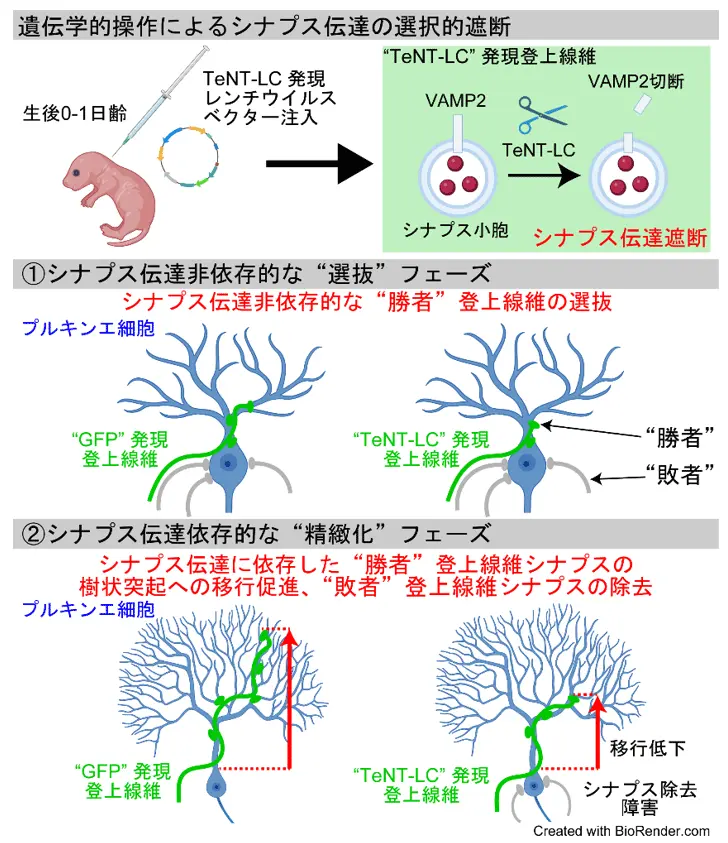
This study challenges the long-held assumption that synaptic transmission is crucial for selecting “winner” inputs during neural circuit refinement. Using developmental synapse elimination in the cerebellum as a model, the researchers found that climbing fibers lacking neurotransmitter release could still become winners. However, synaptic transmission was essential for subsequent steps—the winning input’s expansion into Purkinje cell dendrites and the losing inputs’ elimination. These findings reveal a nuanced role for synaptic activity in neural circuit development: Intrinsic mechanisms likely determine initial input selection, while activity-dependent processes refine and maintain connections. This work provides insights into how precise neural circuits are established during development, with implications for understanding neurodevelopmental disorders.
Abstract
Synaptic transmission has long been thought to regulate neuronal wiring during postnatal development, but this assumption remains largely untested. Selective strengthening of a single “winner” climbing fiber (CF) afferent to each Purkinje cell (PC) and elimination of the other “loser” CF axons in the cerebellum has been a representative model of neural circuit refinement. Here, we examined the role of neurotransmission at CF-PC synapses in their postnatal development. We labeled a subset of CFs in neonatal mice with fluorescent markers and the tetanus toxin light chain to ablate neurotransmitter release from these CFs. Surprisingly, we found that such neurotransmitter release–deficient CFs were able to become the winners. However, synaptic transmission was crucial for the winning CF to extend its synaptic territory along the PC dendritic arbor and eliminate the loser CFs. These findings reveal how synaptic transmission governs multiple steps of synapse elimination but not the selection of the winner input that persists throughout life.