
2025-09-04 中国科学院(CAS)
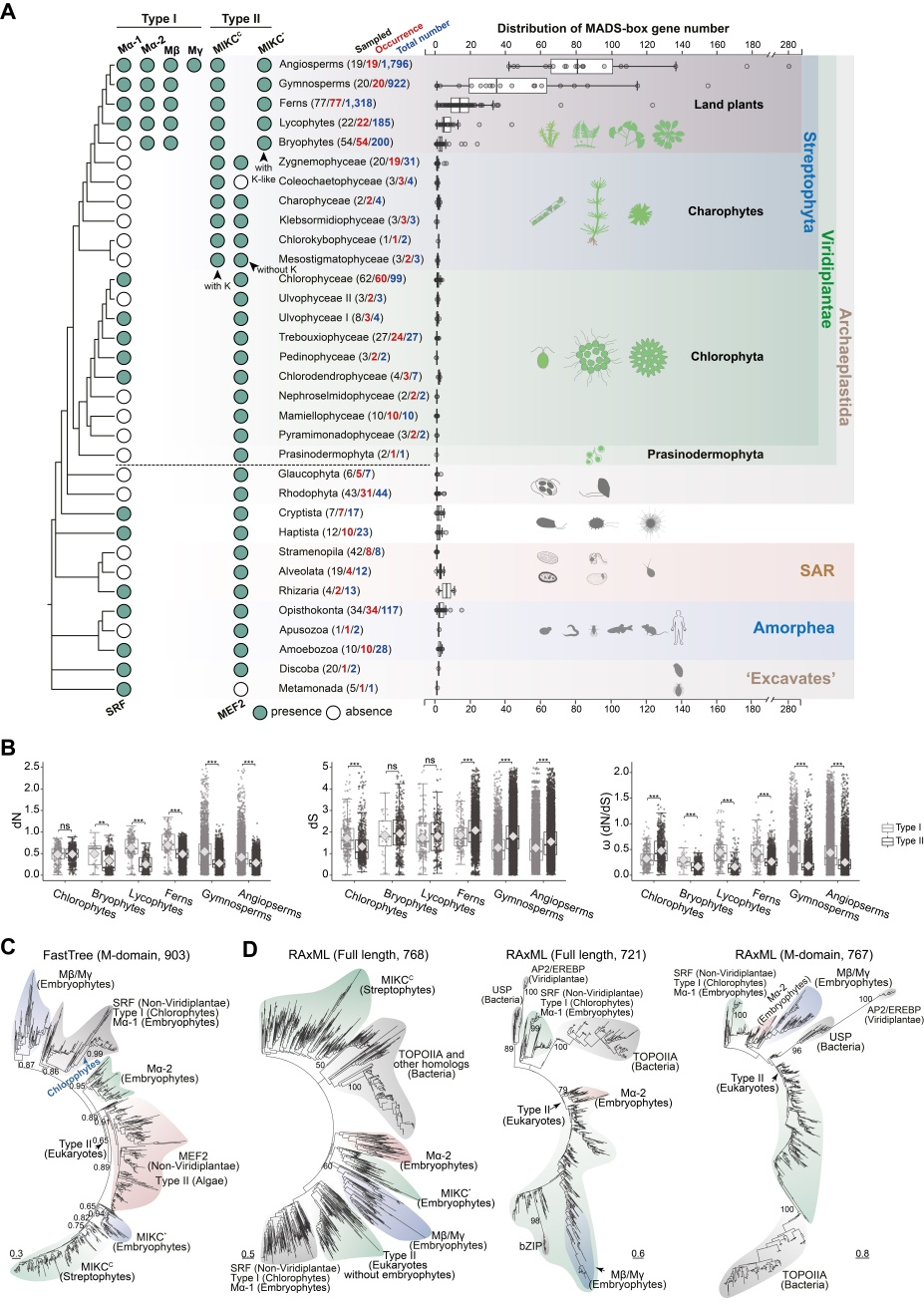 The presence and phylogenetic relationships of MADS-box genes in eukaryotes. (Image by WBG)
<関連情報>
- https://english.cas.cn/newsroom/research_news/life/202509/t20250904_1053922.shtml
- https://www.cell.com/plant-communications/fulltext/S2590-3462(25)00224-X
緑色植物におけるMADS-box転写因子の起源、進化、および多様化 The origin, evolution, and diversification of MADS-box transcription factors in green plants
Jia-Peng Han ∙ Jun-Nan Wan ∙ Zhi-Lin Guan ∙ Han Xu ∙ Qing-Feng Wang ∙ Tao Wan
Plant Communications Published:July 19, 2025
DOI:https://doi.org/10.1016/j.xplc.2025.101462
Abstract
MADS-box genes are among the most important regulatory elements in eukaryotes and have undergone substantial diversification during the evolution of green plants (Viridiplantae). Although the evolution and function of MADS-box genes have been studied extensively, our understanding of their origin and diversification in Viridiplantae remains incomplete. Here, we performed systematic analyses of genomic data from 551 representative eukaryotes, focusing on both sequences and protein structures, to clarify the evolutionary history of MADS-box genes across green-plant lineages. Our analyses suggested that plant type I genes have a polyphyletic origin and that the two subfamilies of plant type II genes (i.e., MIKCC and MIKC∗ genes) arose from an ancient gene duplication in the stem group of streptophytes rather than in land plants. The sphere-like structure of MIKCC proteins revealed in chlorophytes and charophytes is likely an ancestral feature associated with physical constraints to tetramerization. The architectures of MIKCC proteins have evolved greatly in land plants and involve significantly shortened C-termini in which key domains are fully exposed, a structural necessity for tetramer formation. We also documented the diversification of MIKCC genes in ferns, which may have served as the raw genetic basis for their dramatic functional diversification in seed plants.

