2025-09-05 中国科学院(CAS)
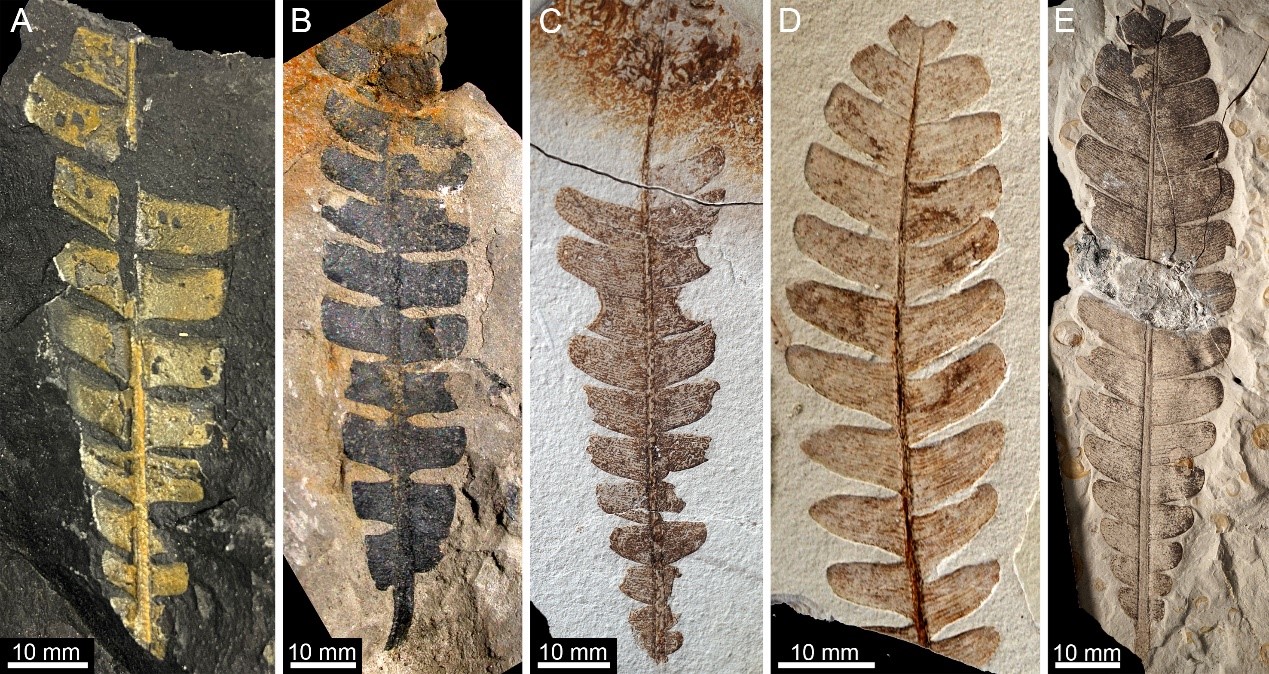 Fossil leaves of Anomozamites. (Image by NIGPAS)
<関連情報>
- https://english.cas.cn/newsroom/research_news/earth/202509/t20250904_1053923.shtml
- https://pubs.geoscienceworld.org/gsa/geology/article-abstract/doi/10.1130/G53399.1/660858/Unique-leaf-mimicry-in-Jurassic-insects
ジュラ紀昆虫に見られる特異な葉の擬態
Unique leaf mimicry in Jurassic insects
Yanzhe Fu;Chong Dong;Dolev Fabrikant;Chenyang Cai;Carolin Haug;Joachim T. Haug;Diying Huang
Geology Published:August 28, 2025
DOI:https://doi.org/10.1130/G53399.1
Animals have evolved diverse defensive strategies under selective pressures, with mimicry being a crucial survival strategy for insects. Leaf mimicry is widespread in modern ecosystems, yet its fossil record remains sparse, often lacking direct evidence of target plant or clear morphological adaptations. We report three novel cases of leaf mimicry in Jurassic orthopterans (grasshoppers and crickets, including katydids) (Prophalangopsidae) from the Daohugou biota (ca. 163.5 Ma, northeastern China), in which the forewings exhibit highly specialized contrasting color patterns that closely resemble the abundantly co-occurring bennettitalean (extinct seed-bearing, cycad-like group) leaves. These cases provide the first unambiguous evidence in which both the mimicking insects and their plant models are preserved in the same bedding plane. It represents the first known instance of orthopteran mimicry in the Jurassic, fills a gap in the fossil record, and suggests that leaf mimicry has been a long-standing adaptive strategy in Orthoptera, independently evolving across different lineages throughout geological history. This finding highlights the dynamic interplay between plant community succession, predation pressures, and insect defensive strategies, expanding our understanding of the ecological significance and evolution of leaf mimicry in orthopterans.