
2025-09-16 カロリンスカ研究所(KI)
Web要約 の発言:
<関連情報>
抗体クラスター化内因性アンジオポエチン-2によるTIE2活性化は実験的腎疾患における毛細血管喪失と線維化を防止する TIE2 activation by antibody-clustered endogenous angiopoietin-2 prevents capillary loss and fibrosis in experimental kidney disease
Riikka Pietilä, Amanda M. Marks-Hultström, Liqun He, Sami Nanavazadeh, Susan E. Quaggin, Christer Betsholtz, and Marie Jeansson
The Journal of Clinical Investigation Published: September 15, 2025
DOI:https://doi.org/10.1172/JCI190286
Graphical Abstract
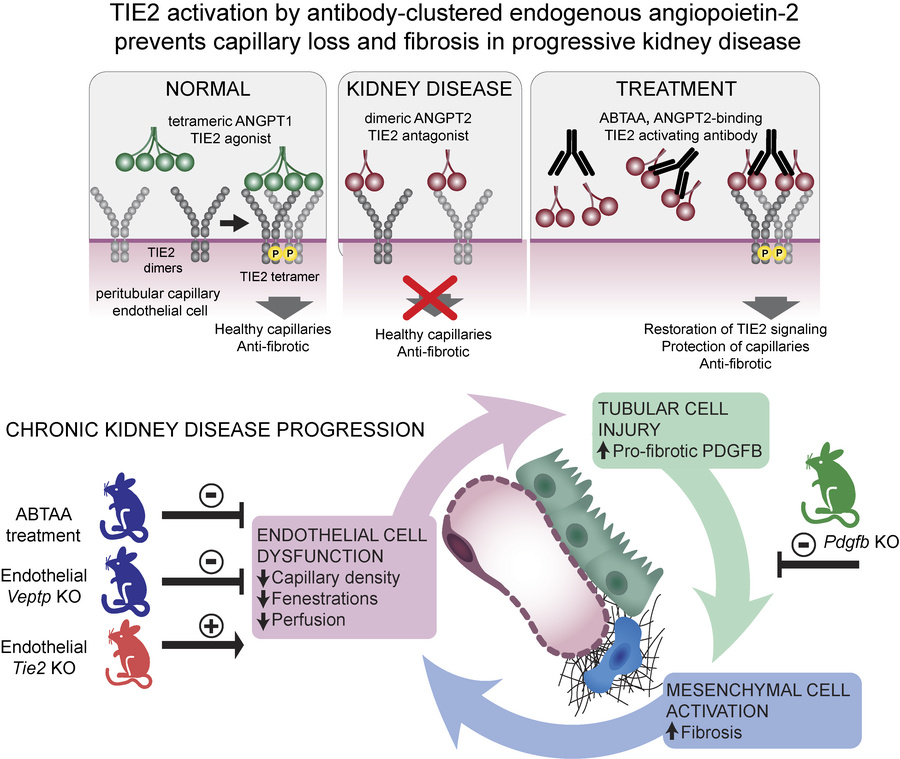
Abstract
The role of endothelial dysfunction in tubulointerstitial fibrosis associated with chronic kidney disease (CKD) is not well understood. In this study, we demonstrate that the activation of the endothelial tyrosine kinase TIE2 alleviates renal pathology in experimental CKD in mice. TIE2 activation was achieved using a human angiopoietin-2 (ANGPT2)-binding and TIE2-activating antibody (ABTAA), or through adult-induced endothelial-specific knockout of the vascular endothelial protein tyrosine phosphatase gene (Veptp). Both methods significantly protected CKD mice from endothelial dysfunction, peritubular capillary loss, tubular epithelial injury, and tubulointerstitial fibrosis. Conversely, silencing TIE2 through adult-induced endothelial-specific knockout of the Tie2 gene exacerbated CKD pathology. Additionally, we found that endothelial dysfunction promotes renal fibrosis not through endothelial-to-mesenchymal transition as previously expected, but by inducing the expression of pro-fibrotic PDGFB in tubular epithelial cells, a process that is inhibited by TIE2 activation. Our findings suggest that TIE2 activation via ABTAA warrants investigation as a therapy in human CKD, where there is a substantial unmet medical need.

