
2025-09-17 アメリカ国立衛生研究所(NIH)
<関連情報>
- https://www.nih.gov/news-events/news-releases/repeated-head-impacts-cause-early-neuron-loss-inflammation-young-athletes?utm_source=chatgpt.com
- https://www.nature.com/articles/s41586-025-09534-6
若年アスリートにおける反復的な頭部外傷は神経細胞の喪失と炎症を引き起こす Repeated head trauma causes neuron loss and inflammation in young athletes
Morgane L. M. D. Butler,Nida Pervaiz,Kerry Breen,Samantha Calderazzo,Petra Ypsilantis,Yichen Wang,Julia Cammasola Breda,Sarah Mazzilli,Raymond Nicks,Elizabeth Spurlock,Marco M. Hefti,Kimberly L. Fiock,Bertrand R. Huber,Victor E. Alvarez,Thor D. Stein,Joshua D. Campbell,Ann C. McKee & Jonathan D. Cherry
Nature Published:17 September 2025
DOI:https://doi.org/10.1038/s41586-025-09534-6
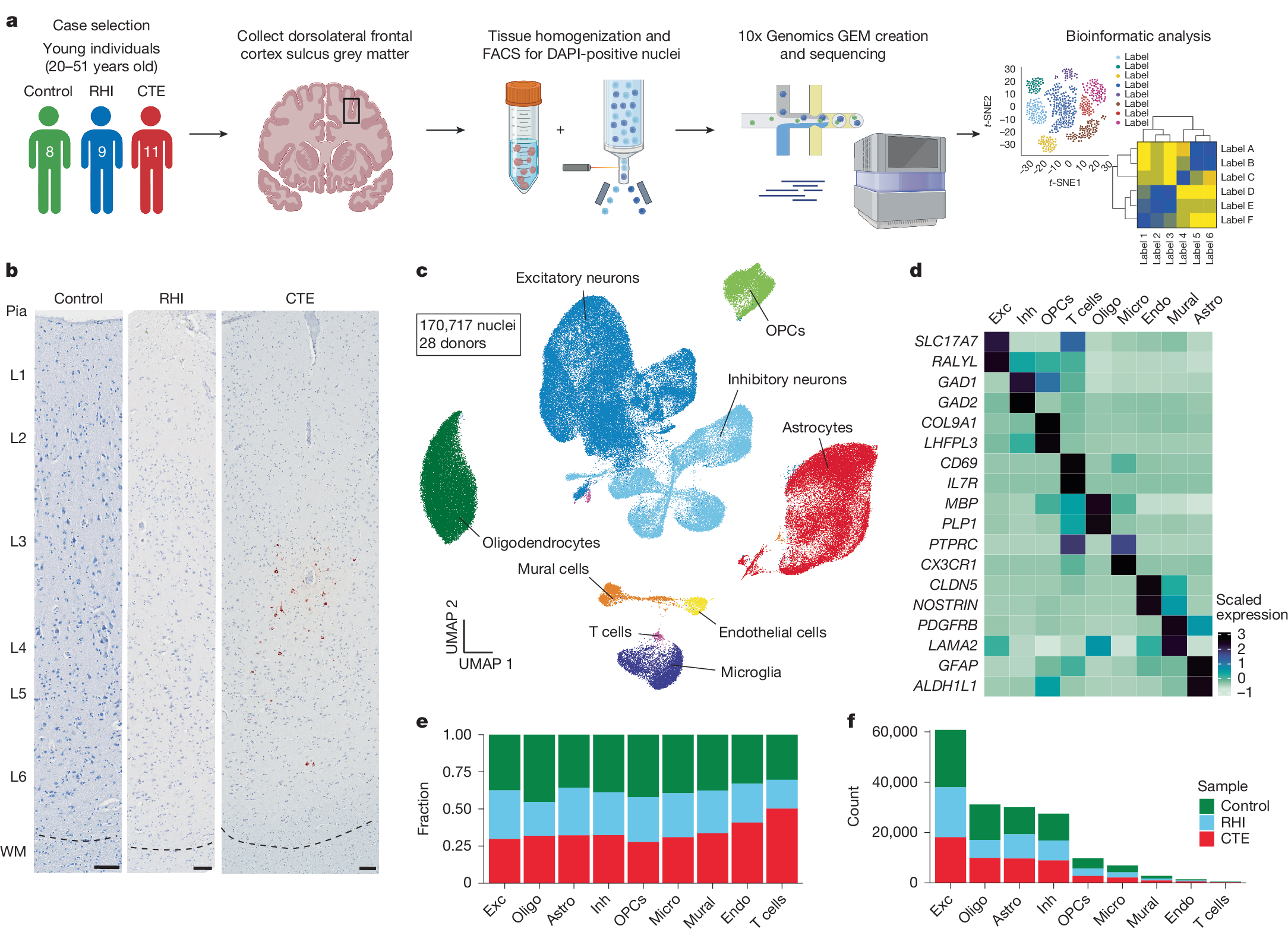
Abstract
Repetitive head impacts (RHIs) sustained from contact sports are the largest risk factor for chronic traumatic encephalopathy (CTE)1,2,3,4. Currently, CTE can only be diagnosed after death and the events that trigger initial hyperphosphorylated tau (p-tau) deposition remain unclear2. Furthermore, the symptoms endorsed by young individuals are not fully explained by the extent of p-tau deposition2, severely hampering therapeutic interventions. Here we observed a multicellular response prior to the onset of CTE p-tau pathology that correlates with number of years of RHI exposure in young people (less than 51 years of age) with RHI exposure, the majority of whom played American football. Leveraging single-nucleus RNA sequencing of tissue from 8 control individuals, 9 RHI-exposed individuals and 11 individuals with low-stage CTE, we identify SPP1-expressing inflammatory microglia, angiogenic and inflamed endothelial cells, astrocytosis and altered synaptic gene expression in those exposed to RHI. We also observe a significant loss of cortical sulcus layer 2/3 neurons independent of p-tau pathology. Finally, we identify TGFβ1 as a potential signal that mediates microglia–endothelial cell cross talk. These results provide robust evidence that multiple years of RHI is sufficient to induce lasting cellular alterations that may underlie p-tau deposition and help explain the early pathogenesis in young former contact sport athletes. Furthermore, these data identify specific cellular responses to RHI that may direct future identification of diagnostic and therapeutic strategies for CTE.

