2025-09-18 スイス連邦工科大学ローザンヌ校(EPFL)
Web要約 の発言:
<関連情報>
- https://actu.epfl.ch/news/new-implant-restores-pressure-balance-after-spinal/
- https://www.nature.com/articles/s41591-025-03614-w
- https://www.nature.com/articles/s41586-025-09487-w
脊髄損傷後の血行動態安定性を回復する埋め込み型システム An implantable system to restore hemodynamic stability after spinal cord injury
Aaron A. Phillips,Aasta P. Gandhi,Nicolas Hankov,Sergio D. Hernandez-Charpak,Julien Rimok,Anthony V. Incognito,Anouk E. J. Nijland,Marina D’Ercole,Anne Watrin,Maxime Berney,Aikaterini Damianaki,Grégory Dumont,Nicolò Macellari,Laura De Herde,Nadine Intering,Donovan Smith,Ryan Miller,Meagan N. Smith,Jordan Lee,Edeny Baaklini,Jean-Baptiste Ledoux,Javier G. Ordonnez,Taylor Newton,Ettore Flavio Meliadò,Clinical Study Team,Onward Team,… Grégoire Courtine
Nature Medicine Published:17 September 2025
DOI:https://doi.org/10.1038/s41591-025-03614-w
Abstract
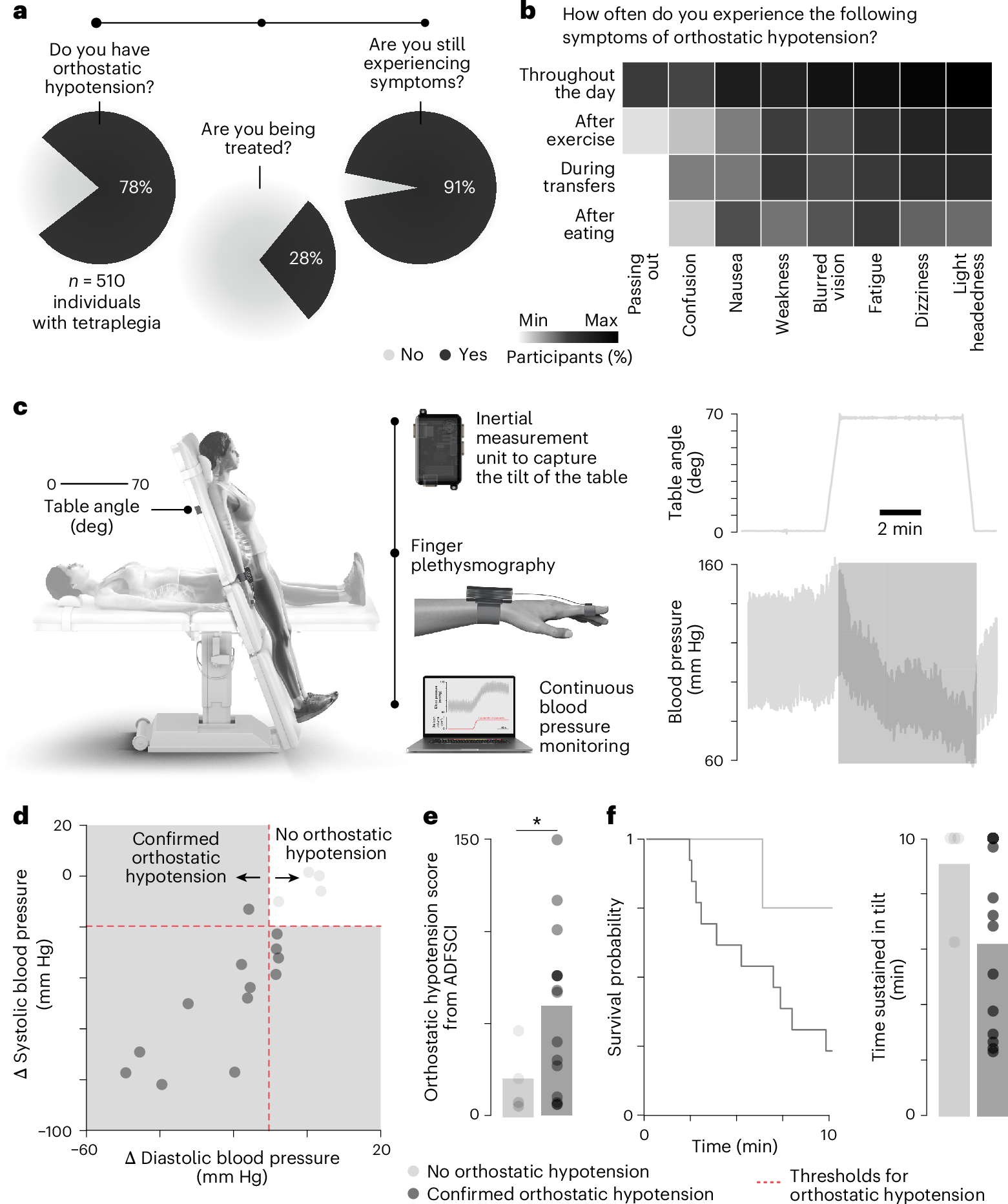
A spinal cord injury (SCI) causes immediate and sustained hemodynamic instability that threatens neurological recovery and impacts quality of life. Here we establish the clinical burden of chronic hypotensive complications due to SCI in 1,479 participants and expose the ineffective treatment of these complications with conservative measures. To address this clinical burden, we developed a purpose-built implantable system based on biomimetic epidural electrical stimulation (EES) of the spinal cord that immediately triggered robust pressor responses. The system durably reduced the severity of hypotensive complications in people with SCI, removed the necessity for conservative treatments, improved quality of life and enabled superior engagement in activities of daily living. Central to the development of this therapy was the head-to-head demonstration in the same participants that EES must target the last three thoracic segments, and not the lumbosacral segments, to achieve the safe and effective regulation of blood pressure in people with SCI. These findings in 14 participants establish the path to designing a pivotal device trial that will evaluate the safety and efficacy of EES to treat the underappreciated, treatment-resistant hypotensive complications due to SCI.
自律神経反射亢進症の基盤となる神経回路構造 A neuronal architecture underlying autonomic dysreflexia
Jan Elaine Soriano,Remi Hudelle,Lois Mahe,Matthieu Gautier,Alan Yue Yang Teo,Michael A. Skinnider,Achilleas Laskaratos,Steven Ceto,Claudia Kathe,Thomas Hutson,Rebecca Charbonneau,Fady Girgis,Steve Casha,Julien Rimok,Marcus Tso,Kelly Larkin-Kaiser,Nicolas Hankov,Aasta Gandhi,Suje Amir,Xiaoyang Kang,Yashwanth Vyza,Eduardo Martin-Moraud,Stephanie Lacour,Robin Demesmaeker,… Gregoire Courtin
Nature Published:17 September 2025
DOI:https://doi.org/10.1038/s41586-025-09487-w
Abstract
Autonomic dysreflexia is a life-threatening medical condition characterized by episodes of uncontrolled hypertension that occur in response to sensory stimuli after spinal cord injury (SCI)1. The fragmented understanding of the mechanisms underlying autonomic dysreflexia hampers the development of therapeutic strategies to manage this condition, leaving people with SCI at daily risk of heart attack and stroke2,3,4,5. Here we expose the neuronal architecture that develops after SCI and causes autonomic dysreflexia. In parallel, we uncover a competing, yet overlapping neuronal architecture activated by epidural electrical stimulation of the spinal cord that safely regulates blood pressure after SCI. The discovery that these adversarial neuronal architectures converge onto a single neuronal subpopulation provided a blueprint for the design of a mechanism-based intervention that reversed autonomic dysreflexia in mice, rats and humans with SCI. These results establish a path towards essential pivotal device clinical trials that will establish the safety and efficacy of epidural electrical stimulation for the effective treatment of autonomic dysreflexia in people with SCI.