2025-09-25 北海道大学,北海道科学大学
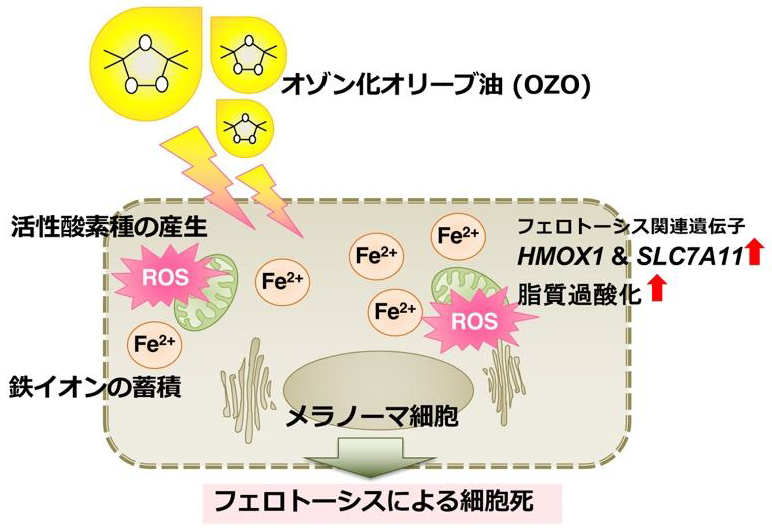
本研究による新たなメラノーマ治療戦略
<関連情報>
- https://www.hokudai.ac.jp/news/2025/09/post-2066.html
- https://www.hokudai.ac.jp/news/pdf/250925_pr2.pdf
- https://www.sciencedirect.com/science/article/pii/S2405580825003541?via%3Dihub
オゾン化オリーブ油はフェロトーシス機構を介してメラノーマ細胞増殖を阻害する Ozonated olive oil inhibits melanoma proliferation by inducing ferroptosis
Seong-Jin An, Jun-Ichi Kashiwakura, Akira Katsuyama, Sumihito Togi Yuichi Kitai, Ryuta Muromoto, Toshiaki Miura, Satoshi Ichikawa, Tadashi Matsuda
Biochemistry and Biophysics Reports Available online: 17 September 2025
DOI:https://doi.org/10.1016/j.bbrep.2025.102267
Highlights
- Ozonated olive oil (OZO) significantly inhibits the growth of human and murine melanoma cells.
- OZO induces ferroptosis-related genes, including HMOX1 and SLC7A11, and lipid peroxidation.
- OZO reduces intracellular GSH and GPX4 protein levels.
- Ferroptosis inhibitors rescue melanoma cells from OZO-induced growth inhibition.
Abstract
Although ozone is a potent oxidant that can damage lungs and skin after prolonged exposure, ozonated olive oil (OZO) exhibits antimicrobial, anti-inflammatory, and wound-healing effects. Here, we describe a novel application of OZO in melanoma therapy. Treatment with OZO markedly inhibited the proliferation of both human and murine melanoma cells, while sparing normal human keratinocyte. At the molecular level, OZO upregulated ferroptosis-related genes, decreased intracellular glutathione (GSH) and GPX4 protein levels and accelerated lipid peroxidation. Critically, OZO-induced growth inhibition in melanoma cells was prevented by ferroptosis inhibitors (ferrostatin-1 and deferiprone), but not by inhibitors of apoptosis or necroptosis. Taken together, these findings offer new therapeutics strategy for treating melanoma by inducing ferroptosis.