
2025-10-06 成育医療研究センター
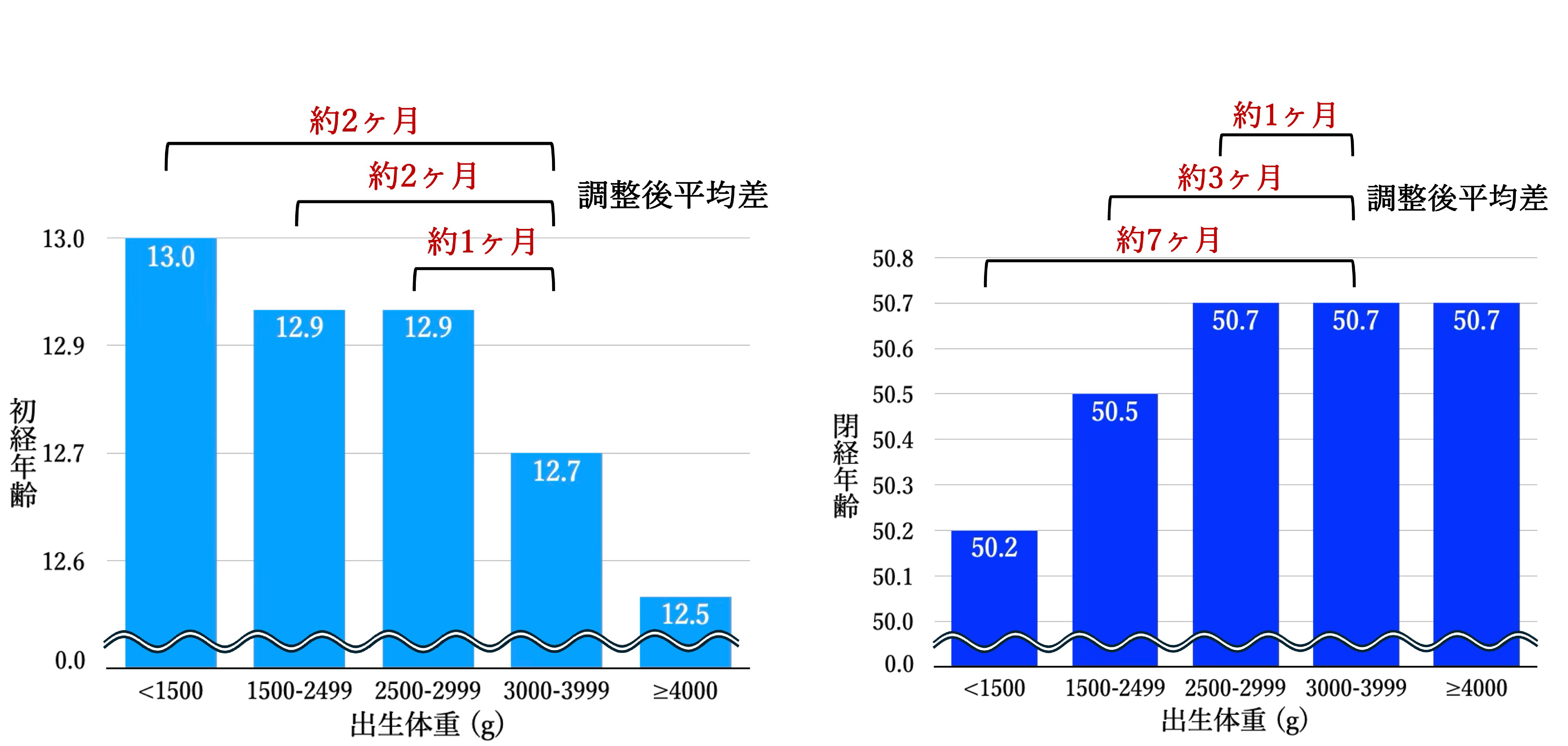
【図1:出生体重が3000~3999gの女性を基準とした場合の初経・閉経年齢との関連】
<関連情報>
- https://www.ncchd.go.jp/press/2025/1006.html
- https://www.ncchd.go.jp/press/2025/1006.pdf
- https://www.jstage.jst.go.jp/article/jea/35/10/35_JE20240305/_article/-char/ja
女性の出生体重と成人期の生殖特性との関連:JPHC-NEXT研究 Association Between Women’s Birth Weight and Reproductive Characteristics in Adulthood: The JPHC-NEXT Study
Shiori Itoi, Chie Nagata, Aurelie Piedvache, Naho Morisaki, Kohei Ogawa, Yoshiko Yamamoto, Isao Saito, Koutatsu Maruyama, Kazuhiko Arima, Kiyoshi Aoyagi, Kozo Tanno, Kazumasa Yamagishi, Isao Muraki, Nobufumi Yasuda, Rieko Kanehara, Taiki Yamaji, Motoki Iwasaki, Manami Inoue, Shoichiro Tsugane, Norie Sawada
Journal of Epidemiology Published: 2025/10/05
DOI:https://doi.org/10.2188/jea.JE20240305
抄録
Background: We aimed to investigate the association between women’s birth weight and their reproductive characteristics.
Methods: We used data from the Japan Public Health Center-based Prospective Study for the Next Generation (JPHC-NEXT), a population-based cohort in Japan. The main analysis included 40,796 women aged 40 to 68 years. Outcomes of interest were age at menarche, age at menopause, history of menstrual irregularity, and nulliparity. Associations between self-reported birth weight categories and outcomes were assessed using either a linear regression or a modified Poisson regression adjusted for potential confounders.
Results: Among participants with complete data, those with lower birth weights (<1,500 g and 1,500–2,499 g) compared to women with a birth weight of 3,000–3,999 g had a later age at menarche (adjusted mean difference [aMD]: 2.4 months and 2.0 months, respectively), earlier age at menopause (aMD: -6.7 months and -2.7 months, respectively), and therefore a shorter reproductive span (aMD: -7.7 months and -4.5 months, respectively). They also had a higher risk of menstrual irregularity (adjusted relative risk [aRR]: 1.19 and 1.11, respectively) and a higher likelihood of nulliparity (aRR: 1.25 and 1.19, respectively).
Conclusion: We observed that Japanese women’s birth weight was significantly associated with reproductive characteristics. Specifically, those with a low birth weight had a shorter reproductive span and a higher risk of irregular menses and nulliparity compared to those with a normal birth weight.
