2025-09-23 バーミンガム大学
<関連情報>
- https://www.birmingham.ac.uk/news/2025/air-pollution-is-harming-childrens-eyesight
- https://academic.oup.com/pnasnexus/article/4/9/pgaf279/8259670
きれいな空気が学童の視力の健康にもたらすメリット Benefits of clean air for school children’s vision health
Xi Chen, Yuqing Dai, Ruihua Wei, Bei Du, Congchao Lu, A Robert MacKenzie, Nai-jun Tang, Zongbo Shi, Hua Yan
PNAS Nexus Published:23 September 2025
DOI:https://doi.org/10.1093/pnasnexus/pgaf279
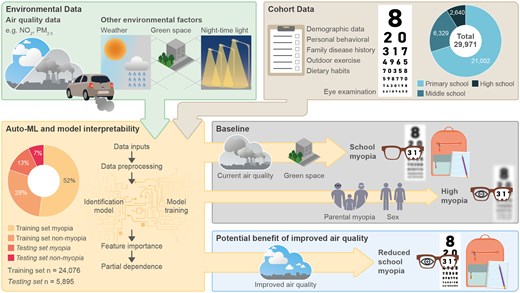
Abstract
Myopia has become a significant public health concern among school-aged children in East Asia. A growing body of evidence acknowledges the multifactorial nature of myopia, including genetic susceptibility, lifestyle habits, and environmental influences. However, the specific role of air quality on vision remains poorly understood due to many confounding variables. Here, we applied an explainable machine learning framework with a large multifactorial cohort to identify key drivers of uncorrected visual acuity and to quantify the potential vision benefits of cleaner air in nearly 30,000 school-aged children. We show that, after controlling for potential confounders, lower ambient nitrogen dioxide and fine particles levels are independently associated with better vision. Primary school students and children with mild-to-moderate myopia benefit more from cleaner air than highly myopic or senior school students. These findings reinforce the emerging view that air pollution plays a significant and modifiable role in visual development. Importantly, our results uniquely indicate that early interventions to reduce air pollution exposure for younger children could yield greater benefits.