2025-10-09 テキサス大学オースチン校 (UT Austin)
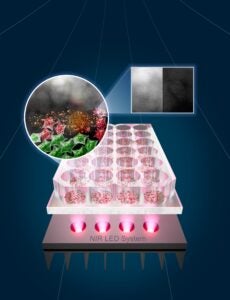
The researchers’ custom near-infrared LED heating system activates SnOx nanoflakes that heat and neutralize cancer cells (green: live cells; red: cells killed by photothermal therapy).
<関連情報>
- https://news.utexas.edu/2025/10/09/led-light-blasts-cancer-cells-and-spares-healthy-ones/
- https://pubs.acs.org/doi/10.1021/acsnano.5c03135
電気化学的に酸化されたSnS 2粉末から合成された強化近赤外線光熱療法剤としてのSnOxナノフレーク SnOx Nanoflakes as Enhanced Near-Infrared Photothermal Therapy Agents Synthesized from Electrochemically Oxidized SnS2 Powders
Hui-Ping Chang,Filipa A. L. S. Silva,Eva Nance,José R. Fernandes,Susana G. Santos,Fernão D. Magalhães,Artur M. Pinto,and Jean Anne C. Incorvia
ACS Nano Published: September 16, 2025
DOI:https://doi.org/10.1021/acsnano.5c03135
Abstract
Near-infrared (NIR) photothermal therapy (PTT) using nanomaterials is a promising strategy for selective cancer treatment. We report two tin-based two-dimensional (2D) nanoflakes─defective SnS2 (SnS2–x) and mixed-phase SnOx─synthesized via top-down ultrasonication and electrochemical exfoliation with oxidation, respectively. Both nanoflakes have thicknesses below 20 nm, and their lateral sizes (<400 nm) were confirmed by AFM, DLS, atomic force microscopy, dynamic light scattering, and transmission electron microscopy (TEM). Despite a similar optical band gap (∼1.89 eV), SnO2 nanoflakes display a significantly enhanced NIR photothermal performance under 810 nm light emitting diode (LED) irradiation. A 3 mg/mL SnOx dispersion increases in temperature by ∼19 °C after 30 min, and a 0.25 mg/mL sample achieves a photothermal conversion efficiency of 93%. X-ray photoelectron spectroscopy and TEM analyses show that SnOx consists of interconnected SnO and SnO2 nanocrystals (<5 nm), which promote nonradiative energy release due to exciton confinement effects, unlike the planar SnS2–x nanoflakes that show negligible heating. In vitro studies demonstrate selective cytotoxicity: SnOx combined with NIR light (100–200 μg/mL, 30 min, 115.2 mW/cm2) reduces viability in SW837 colorectal (-50%) and A431 skin carcinoma cells (-92%), with no cytotoxicity toward human skin fibroblasts. Importantly, the SnOx nanoflakes retain both their photothermal efficiency and structural integrity after four cycles of NIR irradiation, demonstrating stability for repeated therapeutic applications. This work presents a green and scalable method to convert NIR-inactive SnS2 into photothermally active SnOx nanoflakes using only aqueous media and validates SnOx as an efficient, biocompatible PTT agent using low-cost LED sources.