2025-10-21 成育医療研究センター
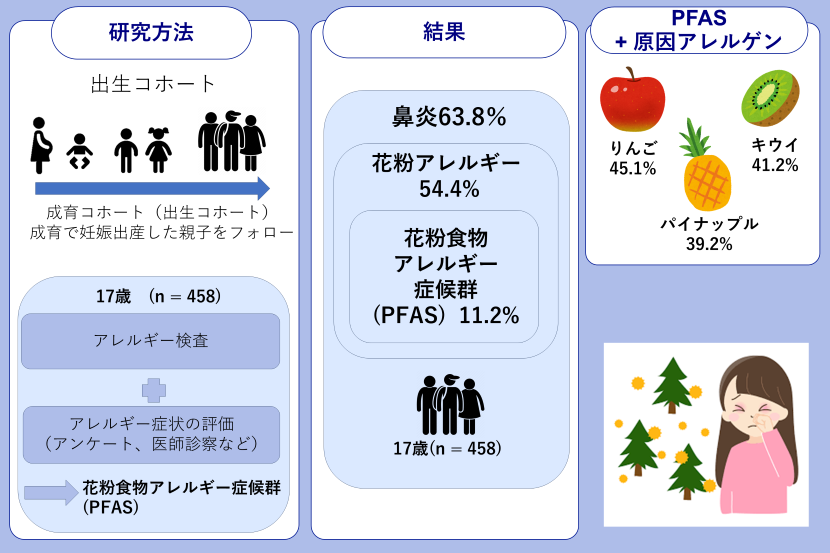
【図1:花粉食物アレルギー症候群(PFAS)の有症率と感作状況】
<関連情報>
- https://www.ncchd.go.jp/press/2025/1021.html
- https://www.ncchd.go.jp/press/assets/1021.pdf
- https://www.jaci-global.org/article/S2772-8293(25)00162-6/fulltext
東京の青少年における花粉食物アレルギー症候群の有病率と感作 Prevalence and sensitization of pollen–food allergy syndrome among adolescents in Tokyo
Tomoyuki Kiguchi, MDa ∙ Tomoki Yaguchi, MDa ∙ Tatsuki Fukuie, MD, PhDa ∙ Yukihiro Ohya, MD, PhDa,b,c,d ∙ Kiwako Yamamoto-Hanada, MD, PhD
Journal of Allergy and Clinical Immunology: Global Published:August 28, 2025
DOI:https://doi.org/10.1016/j.jacig.2025.100561
Abstract
Background
Allergic rhinitis and pollen sensitization typically increase with age; however, longitudinal data on the prevalence of pollen–food allergy syndrome (PFAS) among Japanese adolescents are limited.
Objective
We assessed the prevalence, causal foods, and sensitization status of PFAS among 17-year-olds and explored its association with comorbid allergic conditions.
Methods
This study was conducted as part of the Tokyo Child Health, Disease, and Development Research, a prospective birth cohort study involving the general population. Adolescents aged 17 (range, 16-18) years participated in a cross-sectional survey that included a medical history and health questionnaire, alongside serum IgE testing by ImmunoCAP ISAC. Statistical analyses were performed by descriptive statistics.
Results
Among 458 participants, 54.4% had current pollen allergy and 11.2% had PFAS. The most common causal foods were apples (45.1%), kiwis (41.2%), and pineapples (39.2%). Sensitization rates were high for Cry j 1 (96.1%), Bet v 1 (70.6%), Mal d 1 (64.7%), and Pru p 1 (62.7%). Additionally, 43.1% of adolescents with PFAS had a history of atopic dermatitis, suggesting a link between PFAS and the concept of the allergic march. Rhinitis symptoms peaked in spring, with 79.8% reporting symptoms, particularly in March and April.
Conclusion
This study examined the prevalence and sensitization status of PFAS among Japanese adolescents. PFAS was common in those with pollen allergies and was associated with atopic dermatitis, supporting the allergic march hypothesis. Apples, kiwis, and pineapples were the most frequently implicated foods. These findings underscore the importance of recognizing PFAS in managing adolescent allergic conditions.