2025-10-30 ミュンヘン大学(LMU)
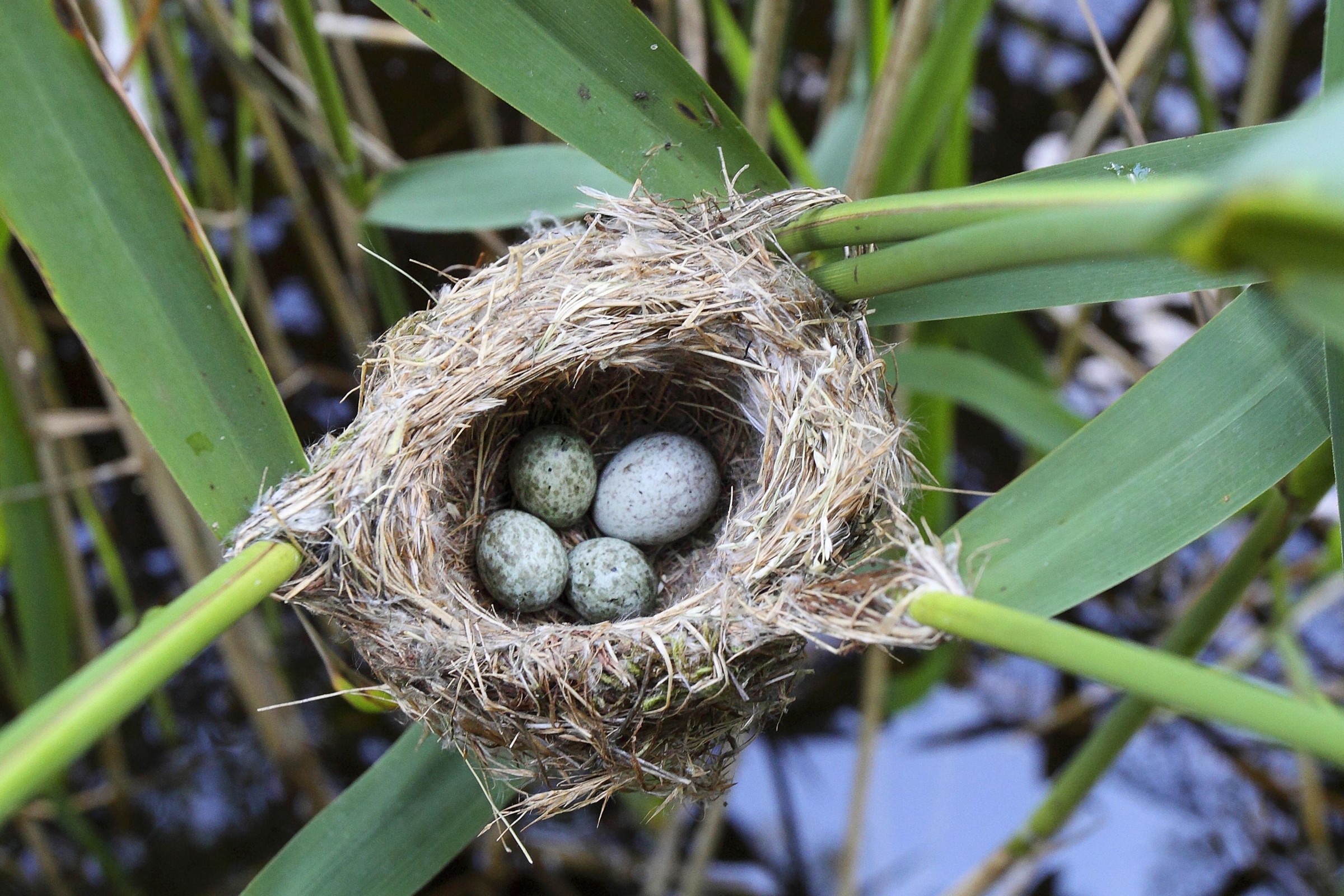 A cuckoo has laid its slightly larger egg in the nest of a reed warbler. | © picture alliance / blickwinkel/W. Buchhorn/F. Hecke | W. Buchhorn/F. Hecker
<関連情報>
- https://www.lmu.de/en/newsroom/news-overview/news/cuckoos-maternal-genes-determine-egg-color.html
- https://www.science.org/doi/10.1126/science.adt9355
- https://medibio.tiisys.com/126167/
托卵カッコウの卵擬態のゲノム構造と種分化への影響 Genomic architecture of egg mimicry and its consequences for speciation in parasitic cuckoos
Justin Merondun, Frode Fossøy, Swetlana Meshcheryagina, Phil Atkinson, […] , and Jochen B. W. Wolf
Science Published:30 Oct 2025
DOI:https://doi.org/10.1126/science.adt9355
Editor’s summary
Parasitic cuckoos face strong selective pressure for their eggs and offspring to match their hosts, yet each species parasitizes multiple hosts. Merondun et al. examined the genetic basis of egg coloration in the common cuckoo (Cuculus canorus) and the oriental cuckoo (C. optatus). In C. canorus, egg coloration was most strongly influenced by maternal variation across morphs, and all 116 single-nucleotide polymorphisms that associated with a blue egg morph located to the female-denoting W chromosome. Males mate opportunistically in C. canorus, potentially explaining the benefit of these traits being closely linked in the matriline. By contrast, this trait appears to be highly polygenic and autosomal in C. optatus, demonstrating the myriad ways that evolution can respond to similar pressures (see the Perspective by Sorenson and Spottiswoode). —Corinne Simonti
Abstract
Host-parasite arms races facilitate rapid evolution and can fuel speciation. Cuculus cuckoos are deceptive egg mimics that exhibit a broad diversity of counterfeit egg phenotypes, representing host-adapted subpopulations (gentes). Genome analysis of 298 common (Cuculus canorus) and 50 oriental cuckoos (Cuculus optatus) spanning 15 egg morphs revealed that eggshell background coloration is predominantly influenced by matrilineal genetic variation. Recurrent mitochondrial mutations and an ancient W chromosome–linked translocation of an autosomal assembly factor for respiratory complex I provide a tentative link between mitochondrial function and pigment synthesis through the heme pathway. Biparentally inherited loci contribute to phenotypic variation in both species, mainly for maculation. The evolutionary tug-of-war over a sex-limited, mimetic trait integrates autosomal components with the nonrecombining, matrilineal genome without catalyzing genome-wide divergence between gentes.