2025-10-28 熊本大学
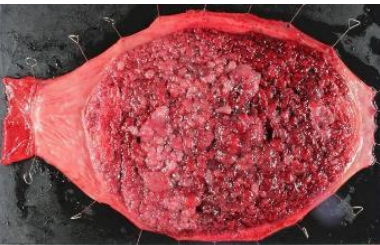
図 1 GAPPS の切除標本写真胃体部~胃底部(写真右側)に限局する多数の胃底腺ポリープを認める。
<関連情報>
- https://www.kumamoto-u.ac.jp/whatsnew/seimei/20251028
- https://www.kumamoto-u.ac.jp/daigakujouhou/kouhou/pressrelease/2025_file/release20251028.pdf
- https://www.pnas.org/doi/10.1073/pnas.2427133122
胃腺癌および胃近位ポリポーシス(GAPPS)患者における発癌のゲノムおよびトランスクリプトーム的全体像 Genomic and transcriptomic landscape of carcinogenesis in patients with gastric adenocarcinoma and proximal polyposis of the stomach (GAPPS)
Chihiro Matsumoto, Kazuki K. Takahashi, Masaaki Iwatsuki, +13 , and Hideo Baba
Proceedings of the National Academy of Sciences Published:October 31, 2025
DOI:https://doi.org/10.1073/pnas.2427133122
Significance
Gastric adenocarcinoma and proximal polyposis of the stomach (GAPPS) is an autosomal dominant syndrome characterized by polyposis localized in the gastric body and fundus with a strong tendency for adenocarcinoma. In this study, we demonstrated that somatic mutations of APC occur in carcinoma and polyp, while mutations of KRAS additionally occur in carcinoma. Furthermore, we revealed that APC and KRAS mutations recurrently co-occur in carcinoma both between cases and within subclones of the same case. KRAS mutations could serve as a biomarker for carcinogenesis in GAPPS, potentially contributing to the early diagnosis of carcinoma and determining the appropriate timing for resection.
Abstract
Gastric adenocarcinoma and proximal polyposis of the stomach (GAPPS) is an autosomal dominant syndrome characterized by polyposis localized in the gastric body and fundus with a strong tendency for adenocarcinoma. The genetic mutations that accumulate during the progression from normal mucosa through polyp to carcinoma in GAPPS remain unclear. We investigated the evolutionary process from normal mucosa to polyp and carcinoma in GAPPS. Through comprehensive mutational and transcriptome analyses, we aimed to provide insights into the biology of this disease. Whole-exome sequencing and RNA sequencing were performed on carcinoma, polyp, and normal mucosa samples from multiple sites from seven patients with GAPPS (n = 54 samples). We comprehensively investigated genomic alterations (including copy number alterations and somatic mutations), clonal architecture, and transcriptome dynamics during carcinogenesis. Genomic evolutionary analysis showed that in GAPPS, somatic mutations of APC occur in carcinoma and polyp while mutations of KRAS additionally occur in carcinoma. We also found the co-occurrence of APC and KRAS mutations in carcinoma recurrently both across cases and within subclones of the same case. The co-occurrence of APC/KRAS mutations may contribute to the carcinogenesis of GAPPS. Our study provides detailed information on the genomic and transcriptomic landscape in GAPPS carcinogenesis, conferring valuable insights into its underlying mechanisms.