2025-11-21 北海道大学,宮城大学,九州大学,福岡工業大学,筑波大学,東京薬科大学
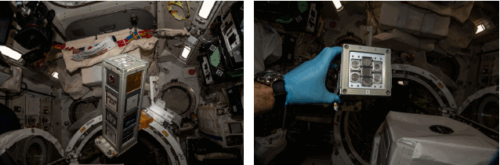
図 4.左:国際宇宙ステーション(ISS)船外実験プラットフォーム(中型曝露実験アダプタ、i-SEEP)に設置された曝露実験ブラケット(ExBAS)。⼀番上に、「たんぽぽ」実験の曝露パネルが格納された。右:宇宙⾶⾏⼠により、ISS 内で「たんぽぽ」実験の曝露パネルが ExBAS に取り付けられた。曝露パネルには、七つの曝露ユニットにヒメツリガネゴケの胞⼦体を含む多様な試料が収められている。本研究ではこの装置を⽤いて、約 9 か⽉間宇宙空間に曝露した。(提供:JAXA/NASA)
<関連情報>
- https://www.hokudai.ac.jp/news/2025/11/post-2125.html
- https://www.hokudai.ac.jp/news/pdf/251121_pr.pdf
- https://www.cell.com/iscience/fulltext/S2589-0042(25)02088-7
ヒメツリガネゴケの極限環境耐性と宇宙空間での生存性 Extreme environmental tolerance and space survivability of the moss, Physcomitrium patens
Chang-hyun Maeng ∙ Yuji Hiwatashi ∙ Keita Nakamura ∙ … ∙ Akihiko Yamagishi ∙ Atsushi Kume ∙ Tomomichi Fujita
iScience Published:November 20, 2025
DOI:https://doi.org/10.1016/j.isci.2025.113827
Highlights
- P. patens spores survive simulated space conditions with high resilience
- Over 80% of spores remained viable after 9 months outside the ISS
- Sporangium may provide protection against UV, heat, and intensive light stresses
- Bryophyte could be used for planetary greening and life support systems
Summary
Climate change highlights the importance of understanding life’s survival limits for addressing global challenges and supporting future human habitation beyond Earth. Plants, as photosynthetic organisms, play a vital role in sustaining life. Bryophytes, such as mosses, show notable extremotolerance, but despite studies on environmental responses in the model moss Physcomitrium patens, its survival under extreme conditions in space remains unclear. We tested protonemata, brood cells, and spores encased in sporangium under simulated space environments, identifying spores as the most resilient, and subsequently exposed them to the space environment outside the International Space Station. After 9 months in space, over 80% of the spores survived, retaining their ability to germinate. These results demonstrate the remarkable resilience of P. patens spores in space and reveal the potential of terrestrial plants to endure extreme environments, providing insight into bryophyte adaptation and offering a foundation for future applications in space exploration and extraterrestrial habitats.