2025-09-02 中国科学院(CAS)
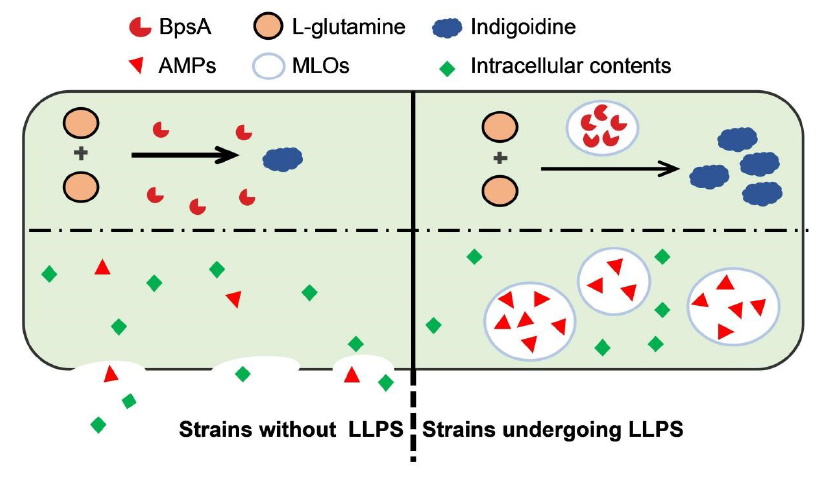
Schematic diagram of LLPS-mediated functional membraneless organelles (Image by SUN Manman)
<関連情報>
- https://english.hf.cas.cn/nr/rn/202509/t20250902_1052658.html
- https://www.sciencedirect.com/science/article/pii/S2405805X25001127
コリネバクテリウム・グルタミカムにおける膜なし細胞小器官の改変によるインジゴイジン生合成と抗菌ペプチド生産の強化 Engineered membraneless organelles in Corynebacterium glutamicum for enhanced indigoidine biosynthesis and antimicrobial peptide production
Manman Sun, Yimeng Zhao, Rodrigo Ledesma-Amaro, Jin Gao, Xiuxia Liu, Zhonghu Bai, Alex Xiong Gao, Peng Wang
Synthetic and Systems Biotechnology Available online: 5 August 2025
DOI:https://doi.org/10.1016/j.synbio.2025.08.001
Abstract
Liquid-liquid phase separation (LLPS)-driven membraneless organelles (MLOs) have been employed to enhance metabolic efficiency in various microbial cell factories. However, their application in the industrial bacterium Corynebacterium glutamicum has not been explored. Here, we report the formation of liquid protein condensates in C. glutamicum using the RGG domain of Caenorhabditis elegans LAF-1. We optimized conditions for condensate formation, including the pre-induction period, inducer concentration, and cultivation temperature. Using the indigoidine biosynthesis pathway as a model, we demonstrated that LLPS-mediated MLOs enhanced indigoidine production. Furthermore, we applied these MLOs to modulate the toxicity of antimicrobial peptides (AMPs) to host cells, facilitating the expression of AMPs, including melittin and lactoferricin B. These findings provide insights into MLOs engineering in C. glutamicum and suggest broader applications of LLPS-mediated systems in industrial biotechnology.