2025-11-21 マウントサイナイ医療システム(MSHS)
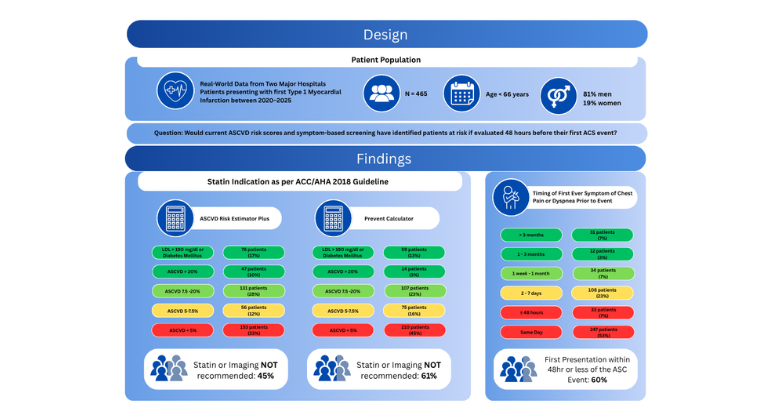
Figure illustrates the distribution of risk categories and symptom timing.
<関連情報>
- https://www.mountsinai.org/about/newsroom/2025/current-heart-attack-screening-tools-are-not-optimal-and-fail-to-identify-half-the-people-who-are-at-risk
- https://www.jacc.org/doi/10.1016/j.jacadv.2025.102361
初回心筋梗塞の予測におけるリスクおよび症状に基づくスクリーニングの限界
Limitations of Risk- and Symptom-Based Screening in Predicting First Myocardial Infarction
Anna S. Mueller, Jonathon Leipsic, Matthew Tomey, Edgar Argulian, Jagat Narula, and Amir Ahmadi
Journal of the American College of Cardiology: Advances Published:21 November 2025
Cardiovascular disease (CVD) remains the leading cause of mortality worldwide, posing a major public health challenge. Traditional screening relies on multivariable risk calculators and symptom evaluation to guide preventive strategies like lipid-lowering therapy and diagnostic testing. Patients deemed low risk and without symptoms are often reassured without further evaluation. Recent evidence suggests that this approach, based on population-level studies linking high atherosclerotic cardiovascular disease (ASCVD) risk scores and symptoms to increased cardiovascular events, may overlook at-risk individuals, as many patients do not align with expected risk profiles.
What is the clinical question being addressed?
Can ASCVD risk scores and symptoms reliably identify patients at risk for a first ACS event?
What is the main finding?
Nearly half of patients who presented with their first MI had low or borderline ASCVD scores, and most experienced no symptoms up until shortly before their event, highlighting missed opportunities for early detection and prevention with our current strategy.
To our knowledge, this is the first study to evaluate the efficacy of risk- and symptom-based screening as gatekeepers for cardiovascular prevention in patients under 66 years of age presenting with their first acute coronary syndrome (ACS) event. By simulating how guideline-directed tools would have performed if applied 2 days before presentation, this study assesses whether these individuals would have been identified as at risk and recommended for preventive therapy or further evaluation.