2025-12-05 中国科学院(CAS)
<関連情報>
- https://english.cas.cn/newsroom/cas_media/202512/t20251205_1135112.shtml
- https://www.nature.com/articles/s41592-025-02912-y
高齢の雌アカゲザルにおける30の組織のマルチオミクス分子地形 A multi-omics molecular landscape of 30 tissues in aging female rhesus macaques
Gong-Hua Li,Xiang-Qing Zhu,Fu-Hui Xiao,Xilong Zhao,Longbao Lv,Fan-Qian Yin,Le Chang,Ming-Xia Ge,Qiang Wang,Jing Zhao,Chuan Tian,Zian Li,Guangping Ruan,Rongqing Pang,Jing Gao,Lihua Ma,Xing-Hua Pan & Qing-Peng Kong
Nature Methods Published:17 November 2025
DOI:https://doi.org/10.1038/s41592-025-02912-y
Abstract
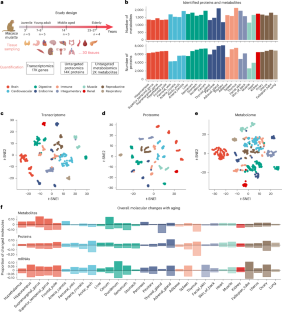
A systematic investigation of aging patterns across virtually all major tissues in nonhuman primates, our evolutionarily closest relatives, can provide valuable insights into tissue aging in humans, which is still elusive largely due to the difficulty in sampling. Here, we generated and analyzed multi-omics data, including transcriptome, proteome and metabolome, from 30 tissues of 17 female rhesus macaques (Macaca mulatta) aged 3–27 years. We found that certain molecular features, such as increased inflammation, are consistent across tissues and align with findings in mice and humans. We further revealed that tissue aging in macaques is asynchronous and can be classified into two distinct types, with one type exhibiting more pronounced aging degree, likely associated with decreased mRNA translation efficiency, and predominantly contributing to whole-body aging. This work provides a comprehensive molecular landscape of aging in nonhuman primate tissues and links translation efficiency to tissue-specific aging.