
2025-12-08 国立成育医療研究センター
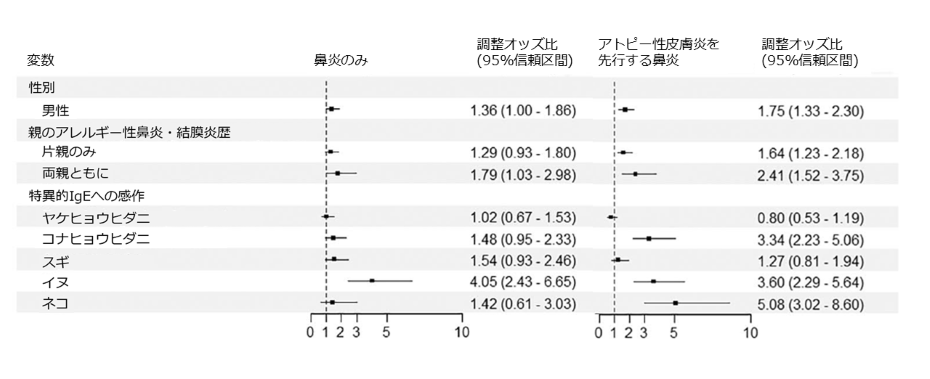 【図1:多変量解析による、主な要因の調整オッズ比】
<関連情報>
- https://www.ncchd.go.jp/press/2025/1208.html
- https://www.ncchd.go.jp/press/2025/1208.pdf
- https://onlinelibrary.wiley.com/doi/10.1111/all.70103
すべての鼻炎がアトピー性疾患の進行を辿るわけではない:JECSコホートにおける3つの表現型における早期の危険因子と感染症の影響 Not All Rhinitis Follows the Atopic March: Early-Life Risk Factors and Implications of Infectious Disease Across Three Phenotypes in JECS Cohort
Daisuke Harama, Mayako Saito-Abe, Kyongsun Pak, Shintaro Iwamoto, Miori Sato, Yumiko Miyaji, Kei Sakamoto, Hidetoshi Mezawa, Minaho Nishizato, Limin Yang, Natsuhiko Kumasaka …
Allergy Published: 21 October 2025
DOI:https://doi.org/10.1111/all.70103
To the Editor,
The global burden of allergic rhinitis (AR) is rising steadily among pediatric populations, often in tandem with other allergic conditions. AR significantly impairs quality of life and imposes substantial healthcare and societal costs across all age groups [1, 2].
The “atopic march” remains a widely accepted paradigm [3]; however, cross-sectional evaluation from the Japan Environment and Children’s Study (JECS) suggests that many cases of allergic rhinitis emerge independently of earlier allergic conditions, indicating that the progression is not uniform across all patients [4]. To date, few studies have dissected AR phenotypes—such as early-onset versus late-onset AR, or AR occurring with versus without prior eczema—based on preceding allergic history—an important gap, given the implications for prevention and management.
This prospective, multicenter birth cohort study (JECS) included 103,060 pregnancies across diverse regions in Japan [5], and included 88,307 newborns delivered at term as singletons (Figure S1). We analyzed the participants from birth to age 4 using serial questionnaires with blood sampling and physical examinations within the sub-cohort. Children diagnosed with AR were classified into three phenotypes based on prior allergic conditions (Table S1 and Figure S2): AD-AR (preceded by atopic dermatitis), Other-AR (preceded by food allergy or asthma), and AR-only (no preceding allergy). Diagnoses of AR and asthma were established using the ISAAC questionnaire [1], while atopic dermatitis (AD) was diagnosed using the UK Working Party criteria. Food allergy was assessed by parent-reported doctor diagnosis. Detailed methods and findings are presented in the Table S2. The study protocol was reviewed by the Ministry of the Environment’s Institutional Review Board (No. 100910001).

