
2025-12-05 量子科学技術研究開発機構
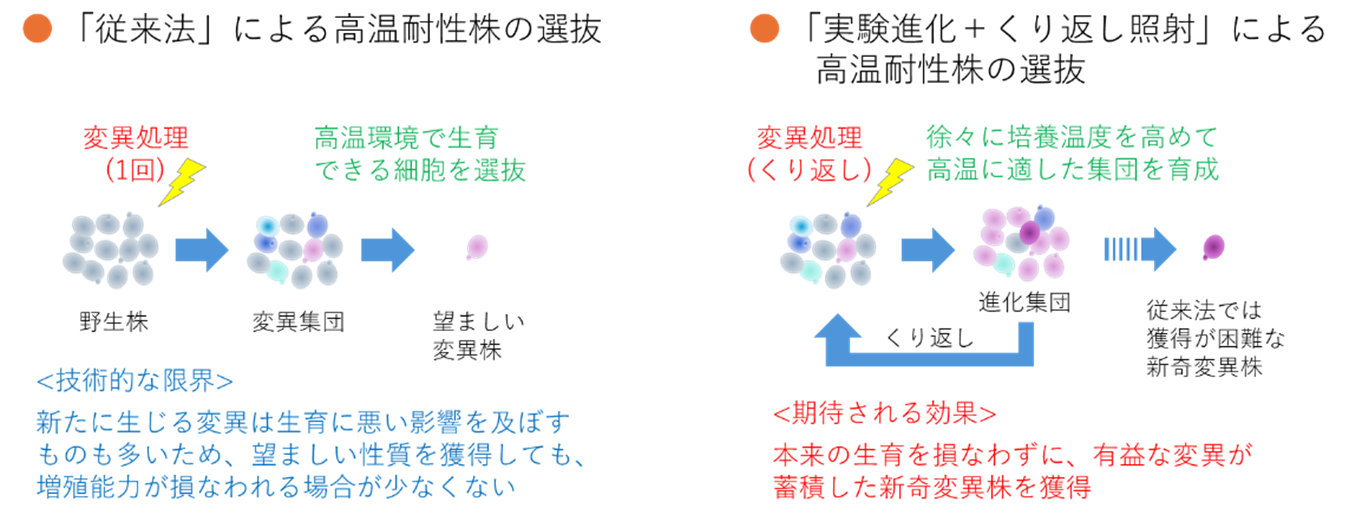 図1 「従来法」と「事件進化+くり返し照射」の違い
<関連情報>
- https://www.qst.go.jp/site/press/20251205.html
- https://www.sciencedirect.com/science/article/abs/pii/S0027510725000223?via%3Dihub
ガンマ線照射によるBradyrhizobium diazoefficiensの繰り返し人工変異誘発は高温耐性の獲得を促進する Repeated artificial mutagenesis of Bradyrhizobium diazoefficiens by gamma irradiation accelerates the acquisition of high-temperature tolerance
Yoshihiro Hase, Ikuko Nagafune, Katsuya Satoh
Mutation Research – Fundamental and Molecular Mechanisms of Mutagenesis Available online: 19 November 2025
DOI:https://doi.org/10.1016/j.mrfmmm.2025.111919
Highlights
- Repeated gamma irradiation accelerated the acquisition of high-temperature tolerance.
- High-temperature-tolerant Bradyrhizobium diazoefficiens mutants were obtained.
- Optimal mutagenesis conditions for accumulating beneficial mutations were revealed.
Abstract
Effective mutant screening is critical for improving industrial microorganisms. This study was conducted to evaluate the effect of repeated mutagenesis with gamma rays on the experimental evolution of rhizobial high-temperature tolerance. Wild-type Bradyrhizobium diazoefficiens USDA110 cells grow optimally at 32-34 °C, but their growth is markedly retarded at 36 °C. Wild-type cells were subcultured in a 96-well deep-well plate for 76 or 83 days, with a gradual increase in temperature from 34.0 to 37.0 °C. Additionally, they were exposed to gamma radiation (1–120 Gy, 10 times in total) during the experimental period. The 40-Gy and 80-Gy treatments generated the most lines with high-temperature-tolerance. However, after extended subculturing without mutagenesis, tolerant lines obtained following the 80-Gy treatment produced smaller colonies than tolerant lines obtained after the 40-Gy treatment, suggesting the accumulation of deleterious mutations. These results imply that approximately 40 Gy is the appropriate dose for accumulating beneficial mutations under our experimental conditions. The two most tolerant lines obtained via the 30-Gy treatment commonly had a mutation in the 16S ribosomal RNA gene and the DNA-directed RNA polymerase subunit beta′ gene (rpoC), possibly reflecting a strong relationship with high-temperature tolerance. The optimal mutagenesis conditions for accumulating beneficial mutations were discussed based on the number of induced mutations in the population.

