2025-12-09 ワシントン大学セントルイス校
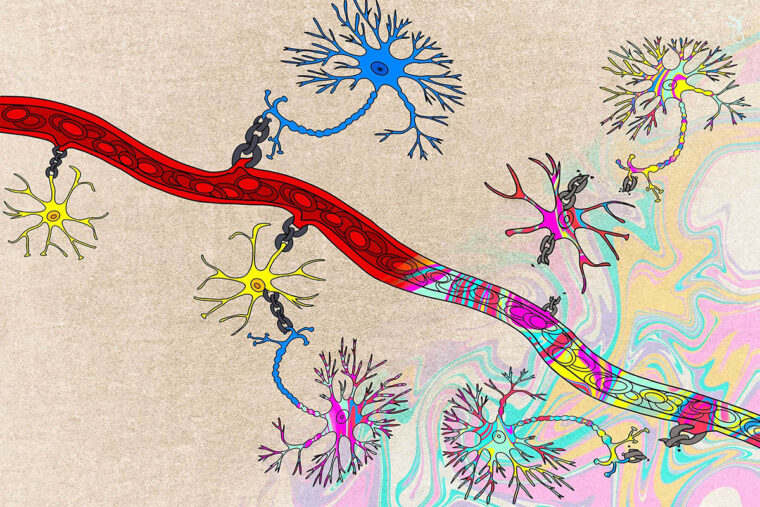
WashU Medicine researchers have shown that certain psychedelic compounds break the link between neurological functions and blood flow in the brain. This could affect the reliability of neuroimaging as an indicator of brain activity in people given the drugs. (Image: Chayla Vazquez/WashU Medicine)
<関連情報>
- https://source.washu.edu/2025/12/psychedelics-disrupt-normal-link-between-brains-neuronal-activity-and-blood-flow/
- https://www.nature.com/articles/s41593-025-02069-z
幻覚剤5-HT 2A受容体作動薬は神経血管結合を変化させ、脳機能の神経細胞および血行動態の測定値に異なる影響を与える Psychedelic 5-HT2A receptor agonism alters neurovascular coupling and differentially affects neuronal and hemodynamic measures of brain function
Jonah A. Padawer-Curry,Oliver J. Krentzman,Chao-Cheng Kuo,Xiaodan Wang,Annie R. Bice,Ginger E. Nicol,Abraham Z. Snyder,Joshua S. Siegel,Jordan G. McCall & Adam Q. Bauer
Nature Neuroscience Published:13 October 2025
DOI:https://doi.org/10.1038/s41593-025-02069-z
Abstract
Human neuroimaging studies report that psychedelics induce serotonin-2A receptor-dependent changes in functional brain reorganization, presumably reflecting neuromodulation. However, these studies often overlook the potent vasoactive effects of serotonin. Here we identified psilocybin-induced alterations in hemodynamic response functions during human functional magnetic resonance imaging, suggesting potential disruptions in neurovascular coupling. We then used wide-field optical imaging in awake Thy1-jRGECO1a mice to determine whether psychedelic-induced changes in hemodynamics arise from neuronal, vascular or neurovascular effects. Exposure to the psychedelic 2,5-dimethoxy-4-iodoamphetamine (DOI) differentially altered coupling between cortical excitatory neuronal versus hemodynamic activity, both during whisker stimulation and in the resting state. Furthermore, DOI resulted in discordant changes between neuronal-based versus hemodynamic-based assessments of functional connectivity. A selective serotonin-2A receptor antagonist (MDL100907) reversed many of the effects of DOI. Our results demonstrate a dissociation between DOI-induced neuronal and hemodynamic signals, indicating a need to consider neurovascular effects of psychedelics when interpreting blood-based measures of brain function.